TL;DR
Kalshi is one CFTC-designated contract market settling in US dollars. Polymarket is two exchanges: a global one collateralized in pUSD on Polygon, and Polymarket US, a CFTC-regulated contract market and clearing organization. Both price fees off P x (1 - P); little else matches.
- Both fee curves peak mid-range and go nearly free at the tails.
- Sports dominates Kalshi. Polymarket splits between sports and politics.
- Kalshi settles centrally. Polymarket's global exchange settles through the UMA oracle.
- A hundred markets carry over half the volume on both venues, so pick the market before the venue.
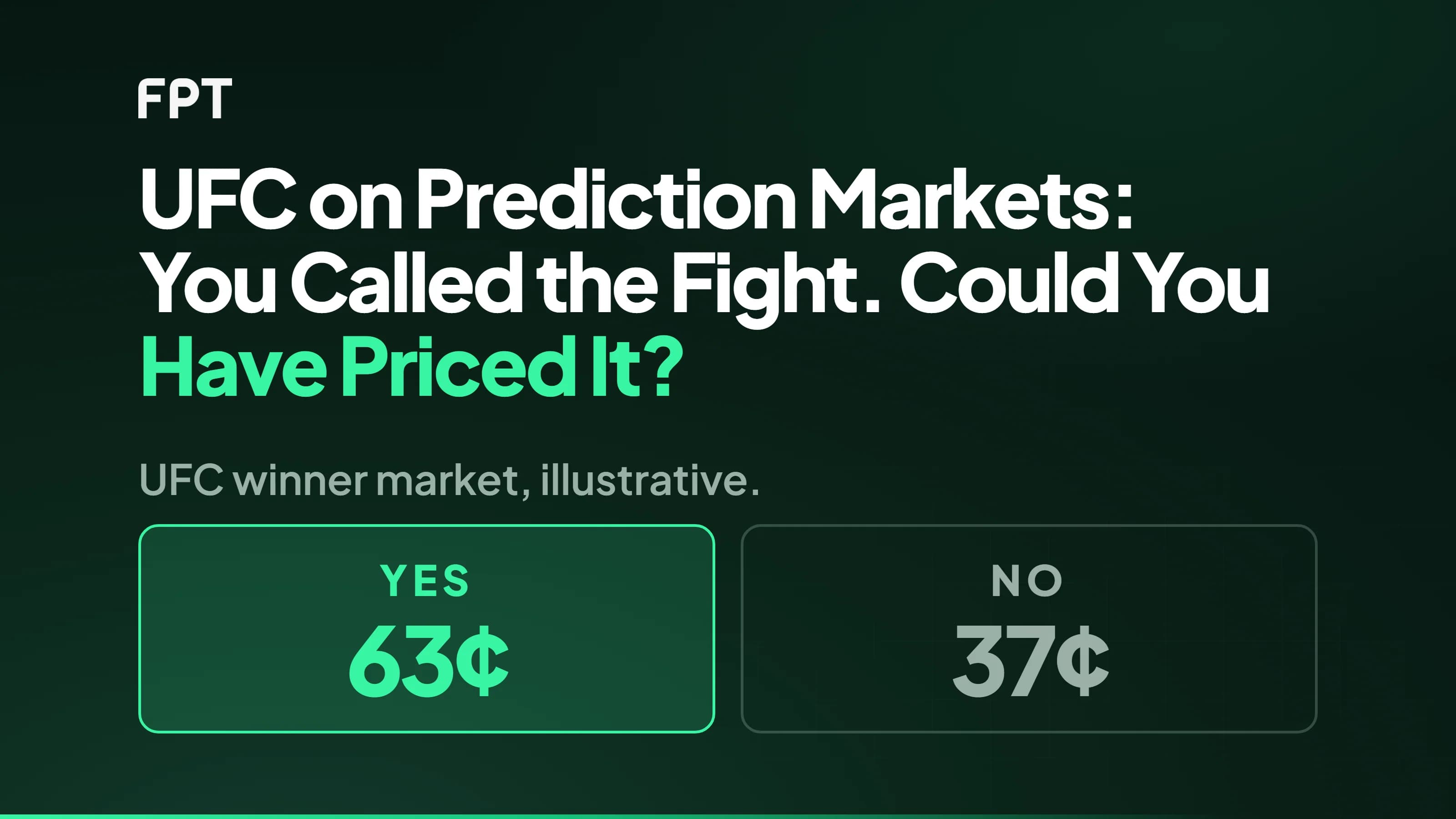
One light-heavyweight fight on the August 1 card sits on both venues at once. Kalshi turns it into a ticker in its KXUFCFIGHT series, settled off The Wall Street Journal, ESPN and Fox Sports. Polymarket turns it into a sentence: UFC Fight Night: Jan Blachowicz vs. Navajo Stirling. It pays both sides evenly on a no contest. Same fight, two different products.
That gap runs the whole way down. The two venues ask the same questions and share almost nothing underneath. Here is each dimension that touches your P&L, and a rule for choosing at the end.
Which Venue Fits Which Edge
- Political or macro forecasting. Polymarket global — a third politics.
- Straight sports outcomes. Either — Kalshi's coefficient sits higher.
- Geopolitics. Only the global exchange charges nothing.
- Resting liquidity. Polymarket US pays the maker.
- Systematic execution. Kalshi's rate-limit tiers, or Polymarket's heartbeat.
- A narrow long-tail thesis. Neither venue, at size.
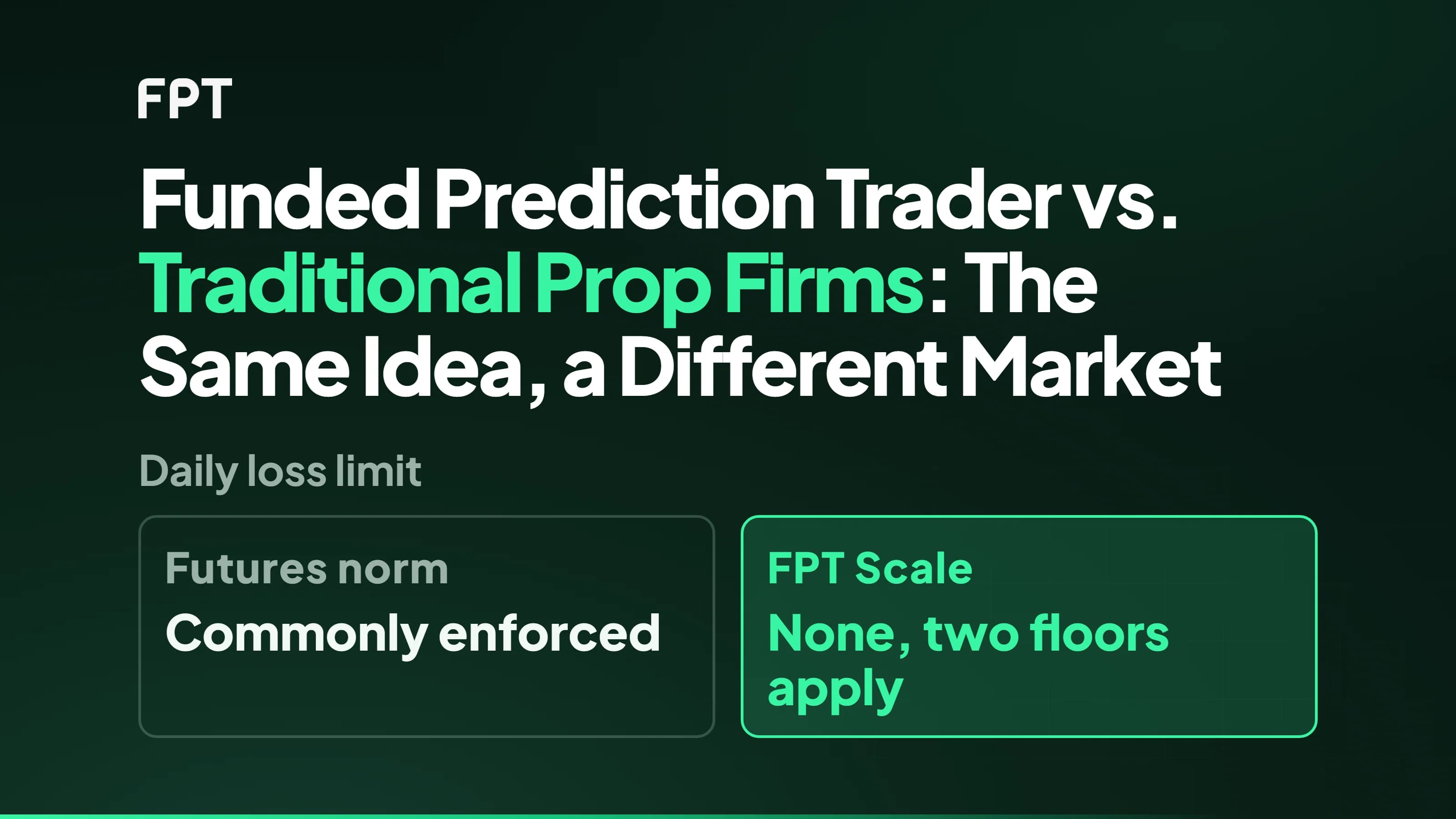
Most traders who take this seriously end up wanting both. That is why the choice matters less than it looks. Funded Prediction Trader (FPT) includes Polymarket and Kalshi with every FPT Scale account. You pick a venue per trade, not per signup. Access still depends on your location and the restrictions that apply to you.
Two Venues, Three Rulebooks
Kalshi says it flat out: it is "regulated as a Designated Contract Market (DCM)" by the Commodity Futures Trading Commission. Polymarket is harder to pin down. Conflating its two halves is the most common mistake written about it.
Three rulebooks, not two
Kalshi
One exchange, US dollars
- A CFTC-designated contract market.
- Every open market carries a one-dollar notional.
- Sports carries most of its volume.
Polymarket (global)
Crypto rails, pUSD collateral
- Collateral moved from USDC.e to pUSD in April.
- pUSD is a Polygon token backed by USDC.
- UMA resolves markets here, not the exchange.
Polymarket US
The regulated sibling
- A CFTC-regulated contract market and clearing organization.
- Operates as QCX LLC, built on the QCEX purchase.
- Sports listed; politics and finance marked coming soon.
So a fee or an eligibility rule on one may not describe the other two. Check which Polymarket you are reading about.
What You Actually Hold
A Kalshi contract is a dollar claim. It pays one dollar if the event happens, nothing if it does not. The price in between is the market's own estimate of how likely that is.
A price is a probability
Custody: Where Your Money Sits
On the global Polymarket exchange your collateral sits in a wallet you control, denominated in pUSD. On Kalshi and on Polymarket US you hold a member account at a US exchange. Both fund in dollars, by card or bank transfer, with crypto on Kalshi. That difference decides how money gets in, how it gets out, and who you call when something breaks.
Where the Volume Sits
Pew Research Center's read on data from The Block is the cleanest independent look. Measured across roughly two years, the two venues are not trading the same thing.
Kalshi's volume mix
- Sports80%
- Everything else9%
- Crypto7%
- Politics4%
- Sports80%
- Everything else9%
- Crypto7%
- Politics4%
Polymarket's volume mix
- Sports39%
- Politics32%
- Crypto20%
- Everything else9%
- Sports39%
- Politics32%
- Crypto20%
- Everything else9%
Politics Made It Famous, Sports Made It Big
Politics is the story everyone tells about prediction markets, not the story of the volume. It ran about ninety percent of Kalshi's flow in the last election cycle. Across the full window it is a low single-digit share. How the category got that big is its own piece.
What a Round Trip Costs
The Curve Peaks in the Middle
Both venues price fees off the same term, P x (1 - P). Cost peaks in the middle of the range and falls away toward the tails. That shape matters more to a thin edge than the venue does.
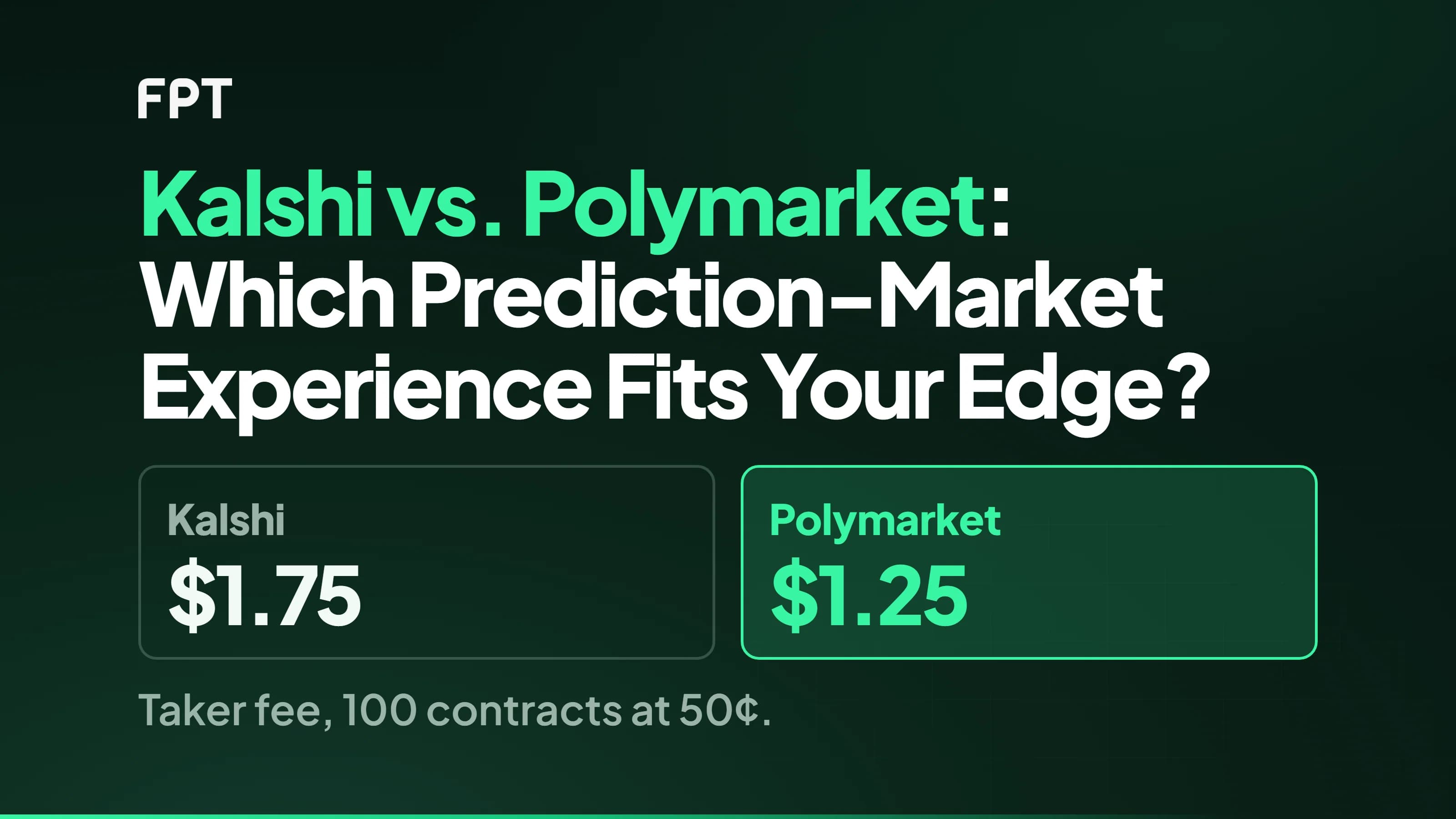
Kalshi's current schedule charges takers round up(M x 0.07 x C x P x (1 - P)), where the multiplier defaults to one. On a standard series that lands in a band of $0.07 to $1.75 per hundred contracts.
Trading fees are only charged for orders that are immediately matched with orders sitting on the orderbook.
Makers Are Treated Differently on Each
Resting an order on a standard Kalshi series is free: the maker multiplier defaults to zero. On the global Polymarket exchange takers pay and makers never do. The rate follows the category — geopolitics is free, sports and politics sit below crypto. Polymarket US goes further and pays the maker a rebate at the trade.
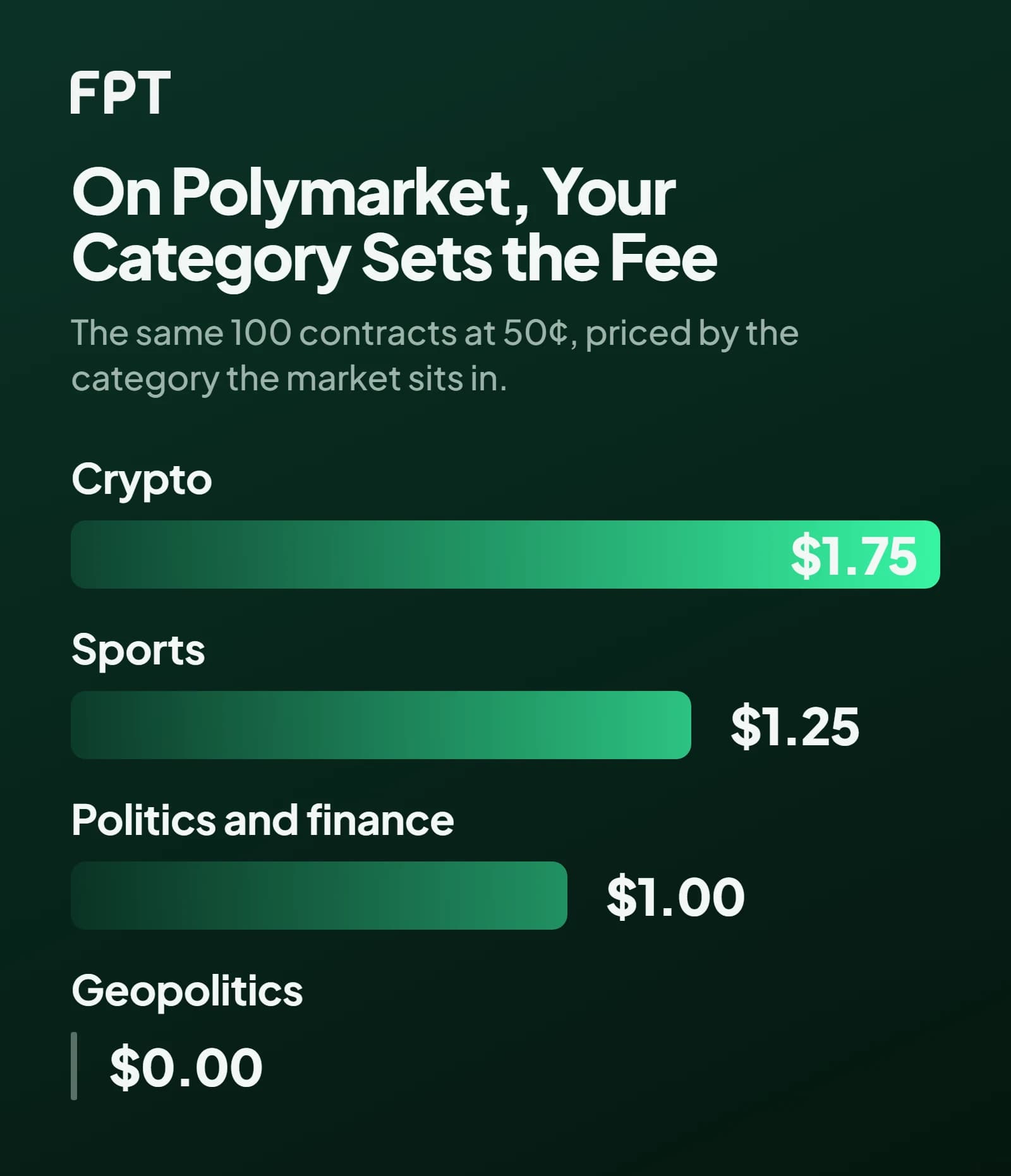
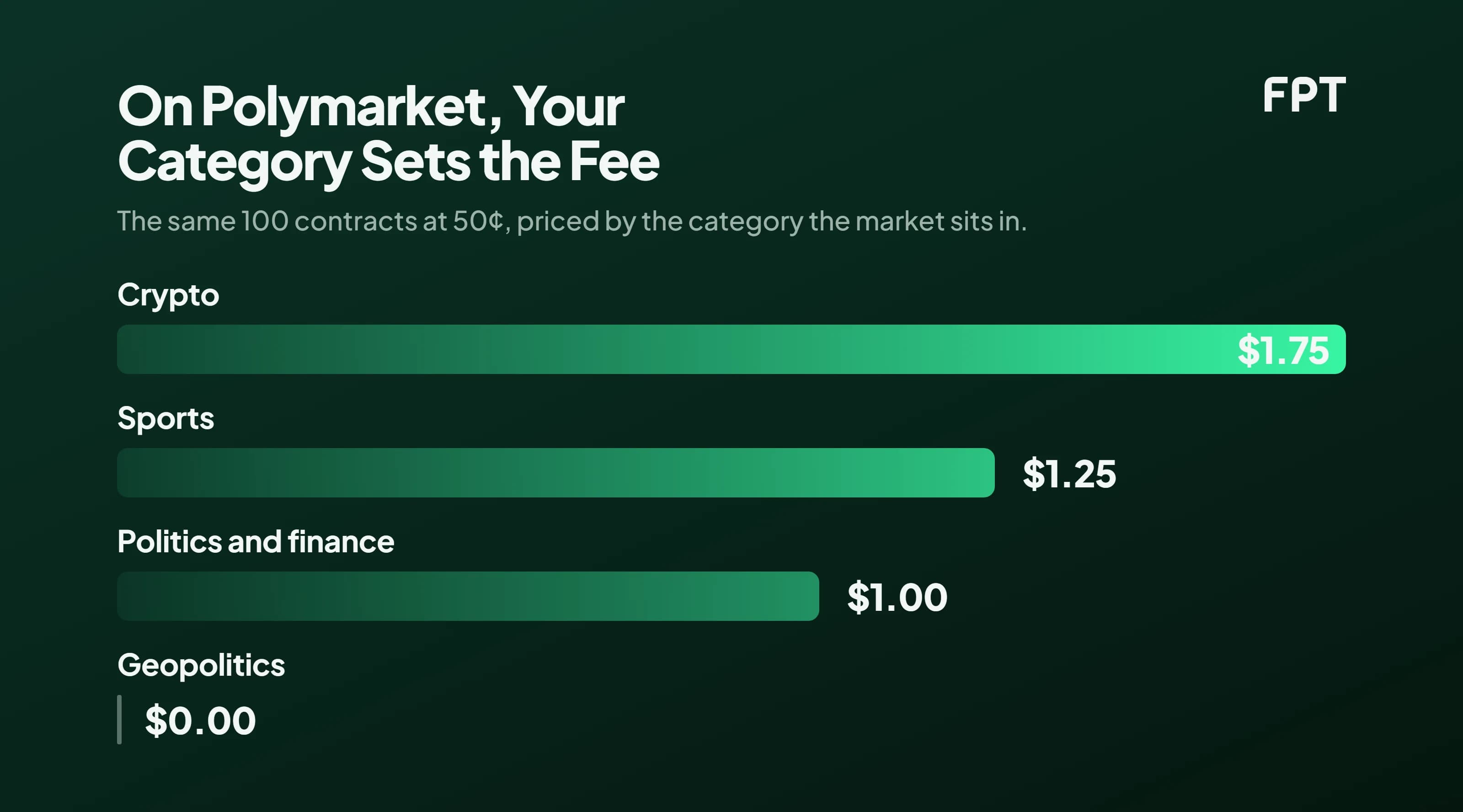
Say you want a hundred contracts at fifty cents, the most expensive point on the curve. The same trade prices four different ways.
Kalshi, standard series
- Role
- Taker
- Cost
- $1.75
Polymarket global, sports
- Role
- Taker
- Cost
- $1.25
Polymarket global, politics
- Role
- Taker
- Cost
- $1.00
Polymarket US
- Role
- Taker
- Cost
- $1.50
Polymarket US
- Role
- Maker
- Cost
- $0.31 back
| Venue | Role | Cost |
|---|---|---|
| Kalshi, standard series | Taker | $1.75 |
| Polymarket global, sports | Taker | $1.25 |
| Polymarket global, politics | Taker | $1.00 |
| Polymarket US | Taker | $1.50 |
| Polymarket US | Maker | $0.31 back |
Every row is a hundred contracts at fifty cents. Move that trade out to ninety cents and every figure falls by roughly two thirds. Kalshi and Polymarket fee schedules, read July 2026.
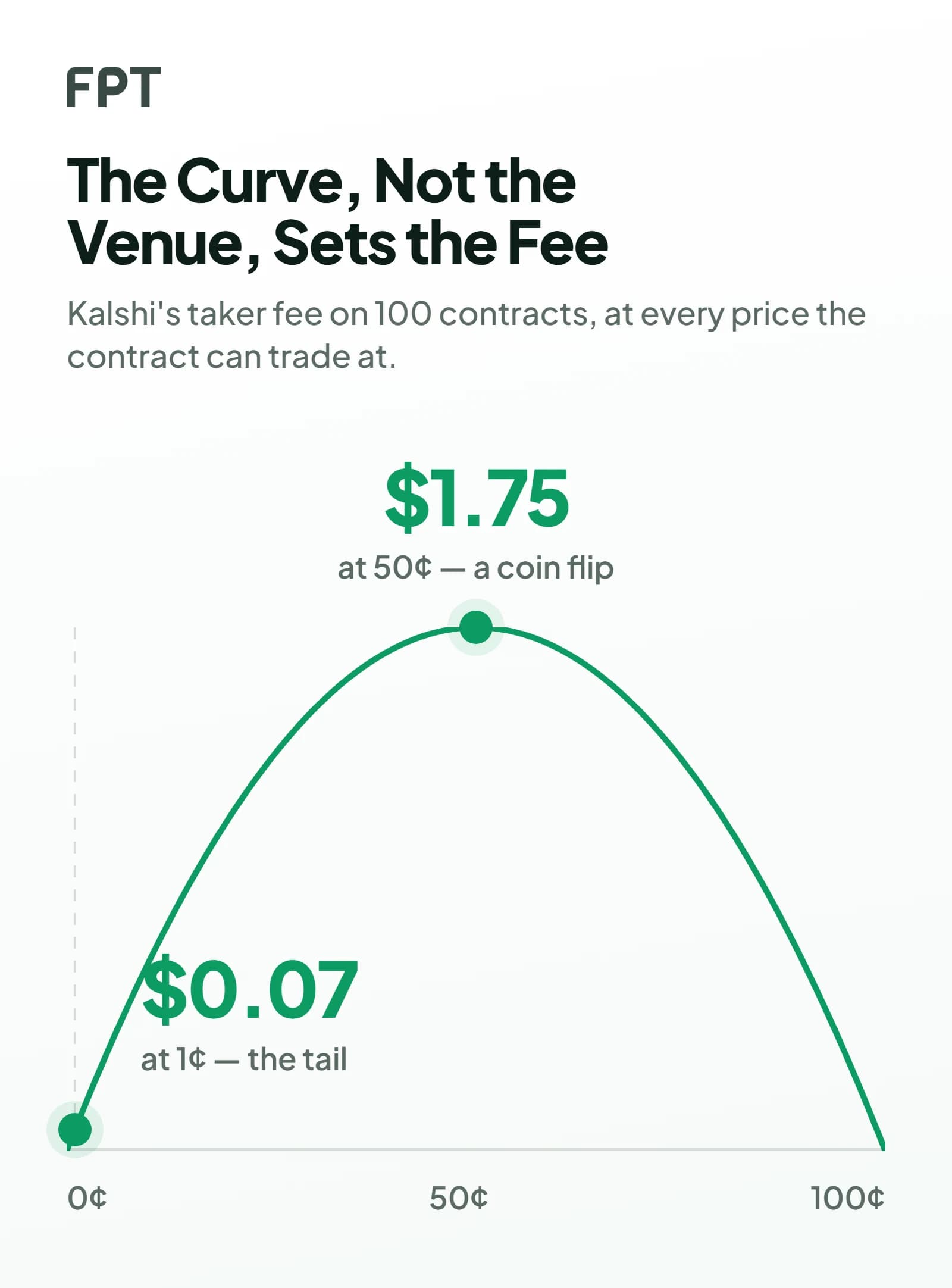
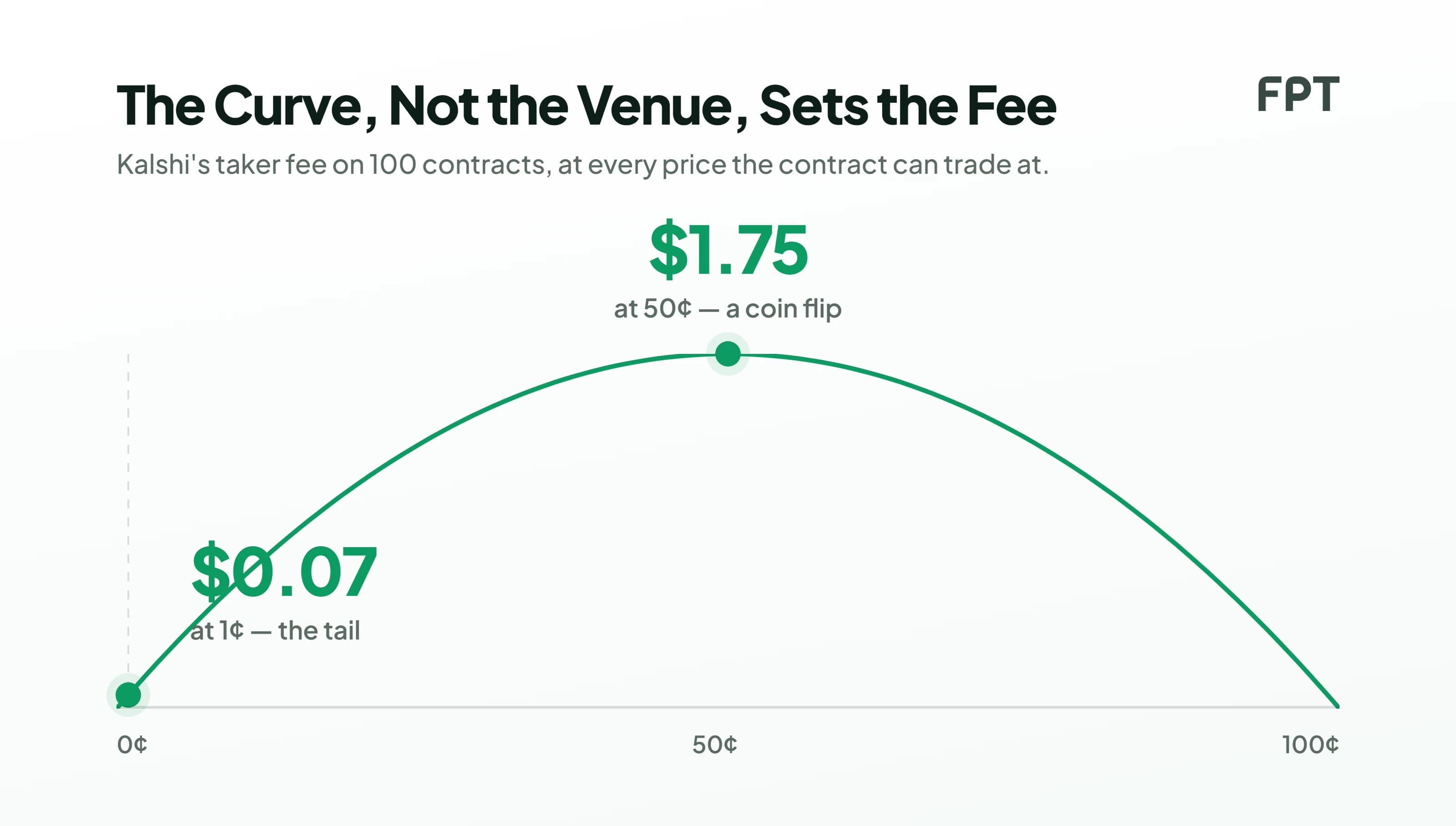
Where you sit on the curve moves your fee more than the venue does.
How Each Venue Handles Your Resting Orders
Same Book, Different Price Grid
Both venues run a central limit order book, so order types are not what separates them. The price grids are. Polymarket mostly quotes in whole cents; most Kalshi markets quote in tenths.
Each Venue Has a Kill Switch
Each will also cancel every order you have resting. The triggers look nothing alike.
Two kill switches, two different triggers
Polymarket: the heartbeat
A liveness check on you
- Send one every five seconds, once heartbeats begin.
- Go quiet ten seconds and its open orders are canceled.
- Punishes a dropped connection.
Kalshi: the order group
A throughput brake on your fills
- A contracts limit measured over a rolling fifteen-second window.
- Hit it and the whole group cancels until you reset.
- Punishes a fast fill run.
Depth, and How Much Size a Book Can Take
Headline volume misleads worst right here. A full census of both venues on one day in late July found the same shape twice.
Among the markets that did trade, the typical one was small. Polymarket's ran a few hundred dollars of daily volume, Kalshi's a few hundred contracts. Two differently built exchanges landed within a point of each other on concentration, which is what a prediction market actually looks like.
Polymarket book depth by volume rank
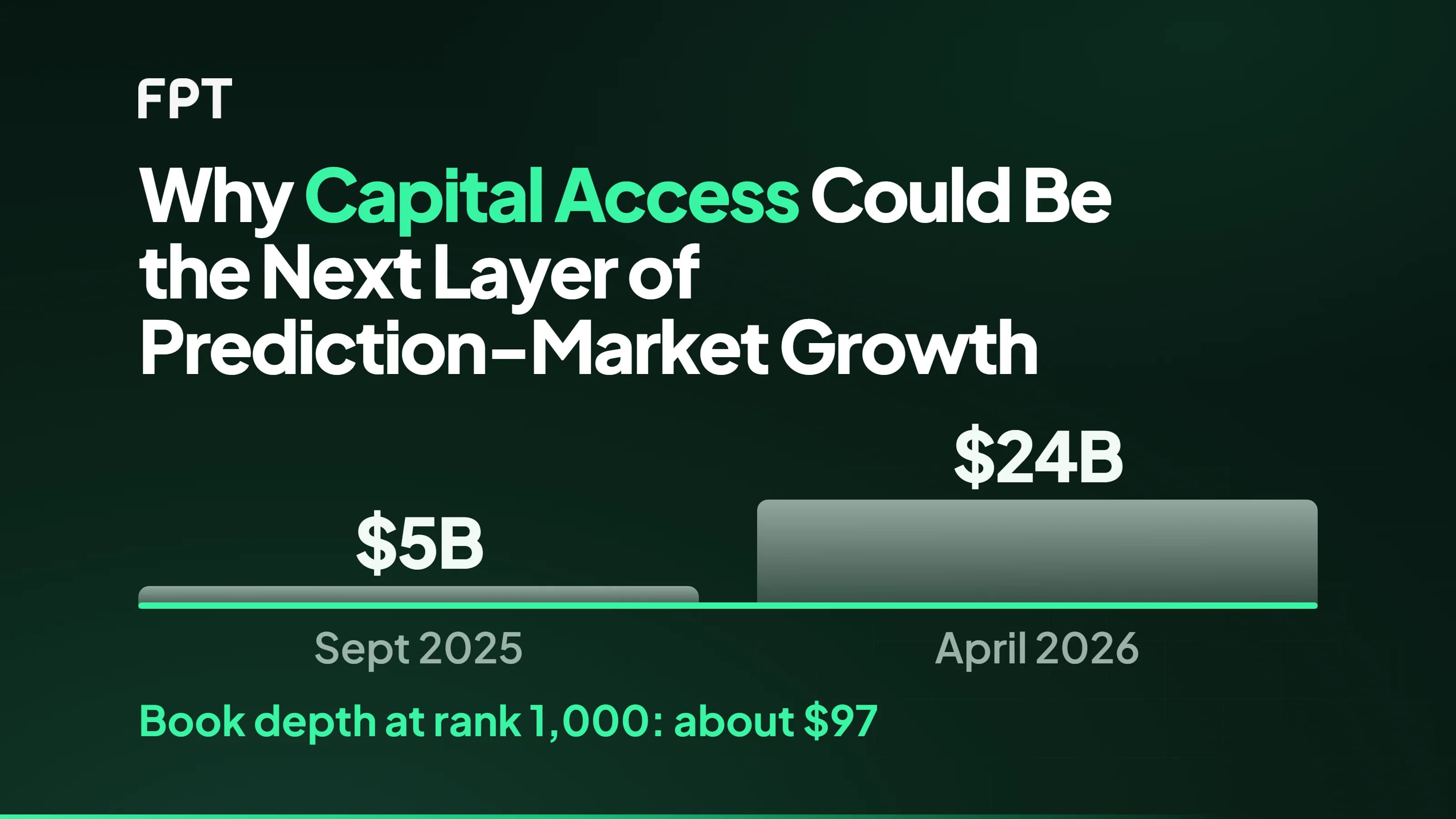
- Around rank 1,000$97
- Around rank 500$249
- The top 15 markets$5,084
What Sets Your Position Size on an FPT Scale Account
This is where the funded model has something concrete to add. On an FPT Scale account, your max open size caps everything you have open at once, and each market is capped separately at five percent of its twenty-four-hour volume. What you can open in a market is whichever of those two is lower.
The account size you see quoted is a rule benchmark, not money to deploy. It is what your profit target, max loss and end-of-day trailing drawdown are measured against. More on funded prediction-market accounts.
Resolution: How Each Venue Settles a Market
Resolution costs traders more than fees do, and gets a fraction of the attention. Kalshi handles it centrally: each contract names its own rules and its own information source. A determination can take an hour, or most of a day. Polymarket's global exchange hands the job to an oracle instead.
How the UMA oracle settles a market
- Start
A proposer posts a bond
A two-hour challenge window opens.
- Two hours in
Unchallenged markets settle
Nobody objects, so the proposal stands.
- If challenged
A disputer posts a matching bond
A second dispute escalates to UMA's Data Verification Mechanism.
- Four to six days
Token holders vote
About two days of voting.
Check the Bond, Not the Docs
Read the bond on the market you are trading rather than quoting the documentation. Polymarket's docs describe a typical bond of $750 in pUSD. Across the highest-volume markets we sampled, not one carried that figure. The common values were $500 and $250.
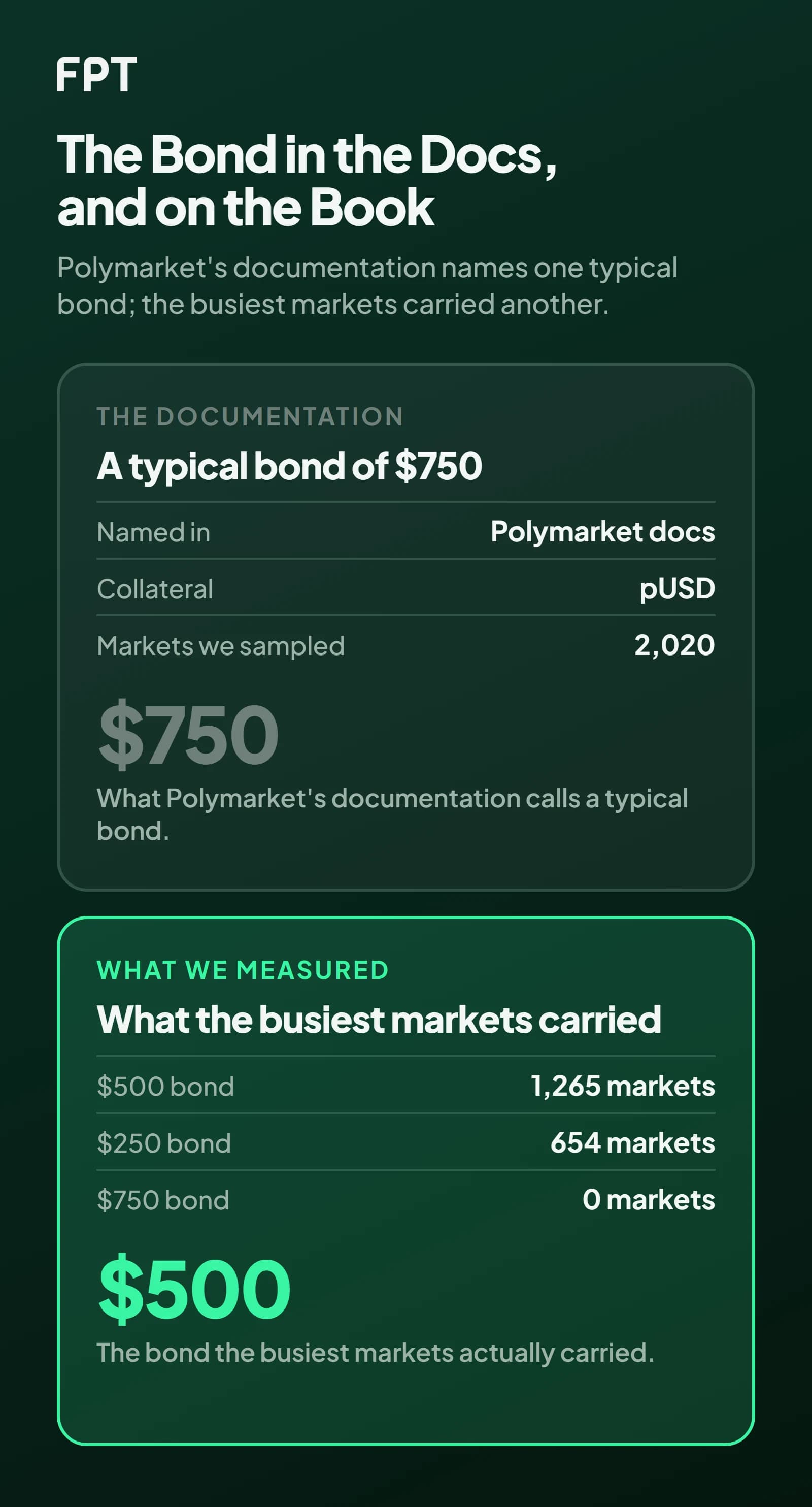
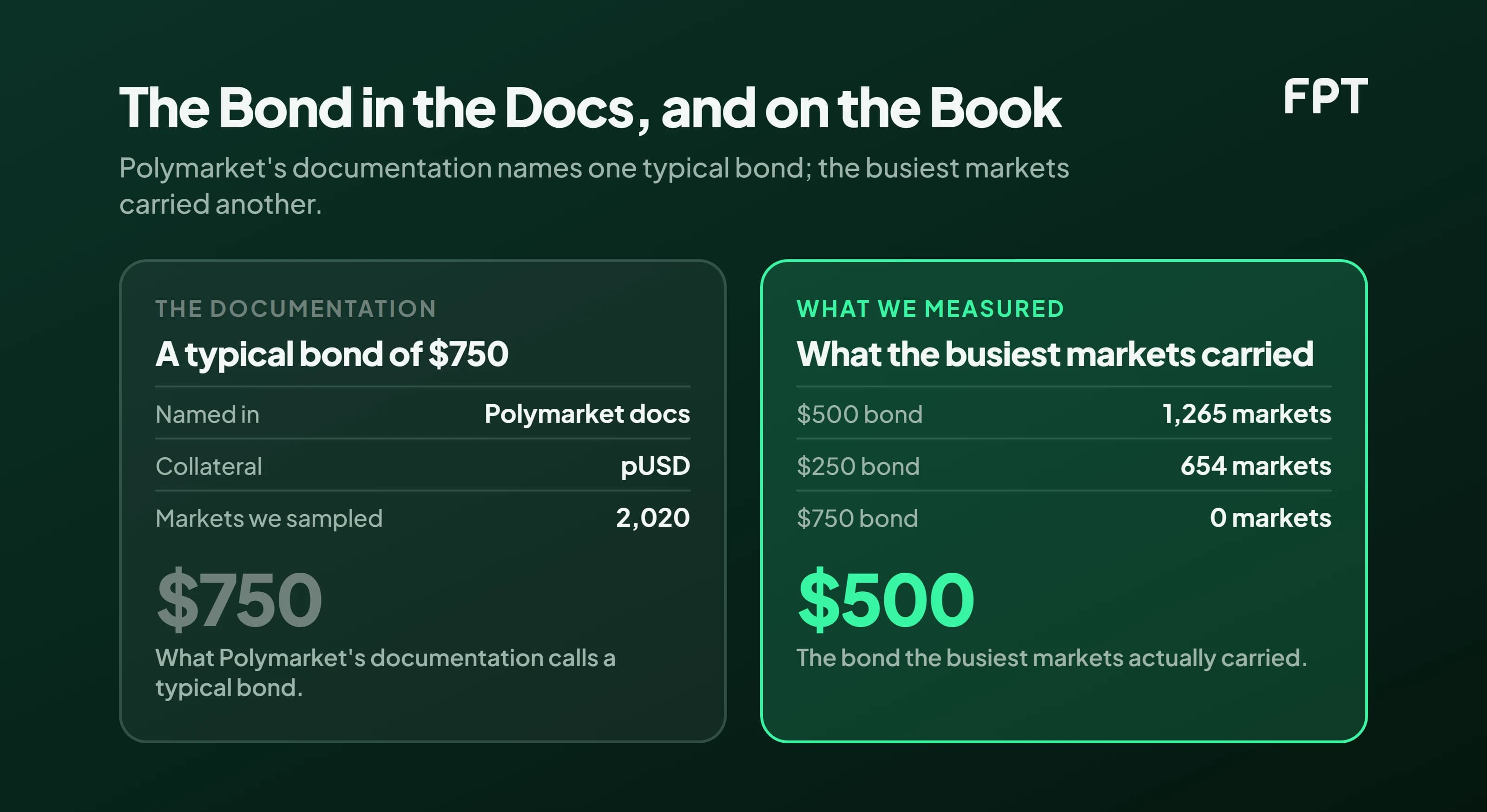
Neither model is better; they simply fail differently. A disputed Kalshi settlement is an exchange decision you take up with the exchange. On the global exchange it is a bonded process anyone can pay to contest.
The Rule for Picking a Venue
Pick by the shape of your edge, and know the weak side going in — no venue wins this outright. A zero fee is not depth, and a deep book on one venue says nothing about the same question on the other.
Neither exchange is a sportsbook, and the mechanical reasons why are worth reading first. A worked example on a fight card walks one event through as markets.
Everything above moves, which is why everything above is dated to when we read it. Polymarket changed its collateral in April and its US fee schedule in July. Before you size a trade, re-read the current fee schedule. Then read the resolution clause of the contract you intend to trade.
Sources & Method
Every venue mechanic here was read on that venue's own documentation, API reference, fee schedule or help center and dated to the retrieval. Category shares come from Pew Research Center's analysis of data from The Block. Concentration, depth, tick-size and resolution-bond figures were measured directly from both venues' public APIs on July 26, 2026 by taking a complete census of every open market on each.
- How is Kalshi regulated? — Kalshi. Accessed Jul 26, 2026.
- What is Polymarket US? — Polymarket US. Accessed Jul 26, 2026.
- Polymarket Receives CFTC Approval of Amended Order of Designation Enabling Intermediated US Market Access — Polymarket, Nov 25, 2025. Accessed Jul 26, 2026.
- Polymarket Acquires CFTC-Licensed Exchange and Clearinghouse QCEX for $112 Million — Polymarket, Jul 21, 2025. Accessed Jul 26, 2026.
- Organization Rules Filing — QCX LLC d/b/a Polymarket US — Commodity Futures Trading Commission, Nov 24, 2025. Accessed Jul 26, 2026.
- Signing Up as an Individual — Kalshi, Mar 10, 2026. Accessed Jul 26, 2026.
- Polymarket USD — Polymarket Documentation — Polymarket. Accessed Jul 26, 2026.
- Polymarket Exchange Upgrade: April 28, 2026 — Polymarket, Apr 28, 2026. Accessed Jul 26, 2026.
- Trading volume on prediction markets has soared in recent months — Pew Research Center, May 27, 2026. Accessed Jul 26, 2026.
- Fee Schedule for July 2026 - 7.7.26 Update — Kalshi, Jul 7, 2026. Accessed Jul 26, 2026.
- Fee Schedule — Kalshi. Accessed Jul 26, 2026.
- Trading Fees — Polymarket Documentation — Polymarket. Accessed Jul 26, 2026.
- Fee Schedule — Polymarket US Documentation — Polymarket US, Jul 1, 2026. Accessed Jul 26, 2026.
- Orders Overview — Polymarket Documentation — Polymarket. Accessed Jul 26, 2026.
- Resolution — Polymarket Documentation — Polymarket. Accessed Jul 26, 2026.
- Market Outcomes — Kalshi. Accessed Jul 26, 2026.
- Transfers FAQ — Kalshi, Jun 18, 2026. Accessed Jul 26, 2026.
- Rate Limits — Kalshi API Documentation — Kalshi. Accessed Jul 26, 2026.
- Polymarket Gamma API — markets (keyset pagination) — Polymarket. Accessed Jul 26, 2026.
- Kalshi Trade API — markets — Kalshi. Accessed Jul 26, 2026.
- Kalshi Trade API — series KXUFCFIGHT — Kalshi. Accessed Jul 26, 2026.
- Kalshi Trade API — open events in series KXUFCFIGHT — Kalshi. Accessed Jul 26, 2026.
- Polymarket Gamma API — event ufc-jan-nav-2026-08-01 — Polymarket. Accessed Jul 26, 2026.
- Create Order (V2) — Kalshi API Documentation — Kalshi. Accessed Jul 26, 2026.
- Create Order Group — Kalshi API Documentation — Kalshi. Accessed Jul 26, 2026.
- Polymarket CLOB API — order book endpoint (one token_id per call) — Polymarket. Accessed Jul 26, 2026.
- Kalshi API Documentation — Kalshi. Accessed Jul 26, 2026.
- Rate Limits — Polymarket Documentation — Polymarket. Accessed Jul 26, 2026.
- Polymarket US Documentation Index — Polymarket US. Accessed Jul 26, 2026.
- Payments Overview — Polymarket US Documentation — Polymarket US. Accessed Jul 26, 2026.
Common Questions
Which venue is cheaper, Kalshi or Polymarket?
It depends far more on price and category than on the venue. Both schedules are built on P x (1 - P), so cost peaks at 50 cents and collapses toward the tails. At 50 cents, 100 contracts cost $1.75 on Kalshi's standard schedule, $1.25 in Polymarket's sports category, $1.00 in its politics category and $1.50 on Polymarket US.
Are Kalshi and Polymarket regulated the same way?
No. Kalshi states it is regulated by the CFTC as a Designated Contract Market. Polymarket runs two exchanges: a global crypto-collateralized venue and Polymarket US, a CFTC-regulated designated contract market and derivatives clearing organization operating as QCX LLC. A fact about one does not automatically describe the other.
Which venue has more liquidity?
That is the wrong unit. On a full census of both venues on July 26, 2026, the top 100 markets carried roughly 56% of each venue's 24-hour volume, and most listed markets traded nothing at all. Ask which market has depth, on the day you intend to trade it, rather than which venue does.
Can I use both venues from where I live?
Neither platform publishes the availability table people expect. Kalshi defers its restricted-jurisdiction list to Section VI of its Member Agreement, and we found no first-party state-by-state list for Polymarket US. Check each platform's own eligibility documentation and terms directly; third-party availability tables are inference, not policy.
Referenced on this site