TL;DR
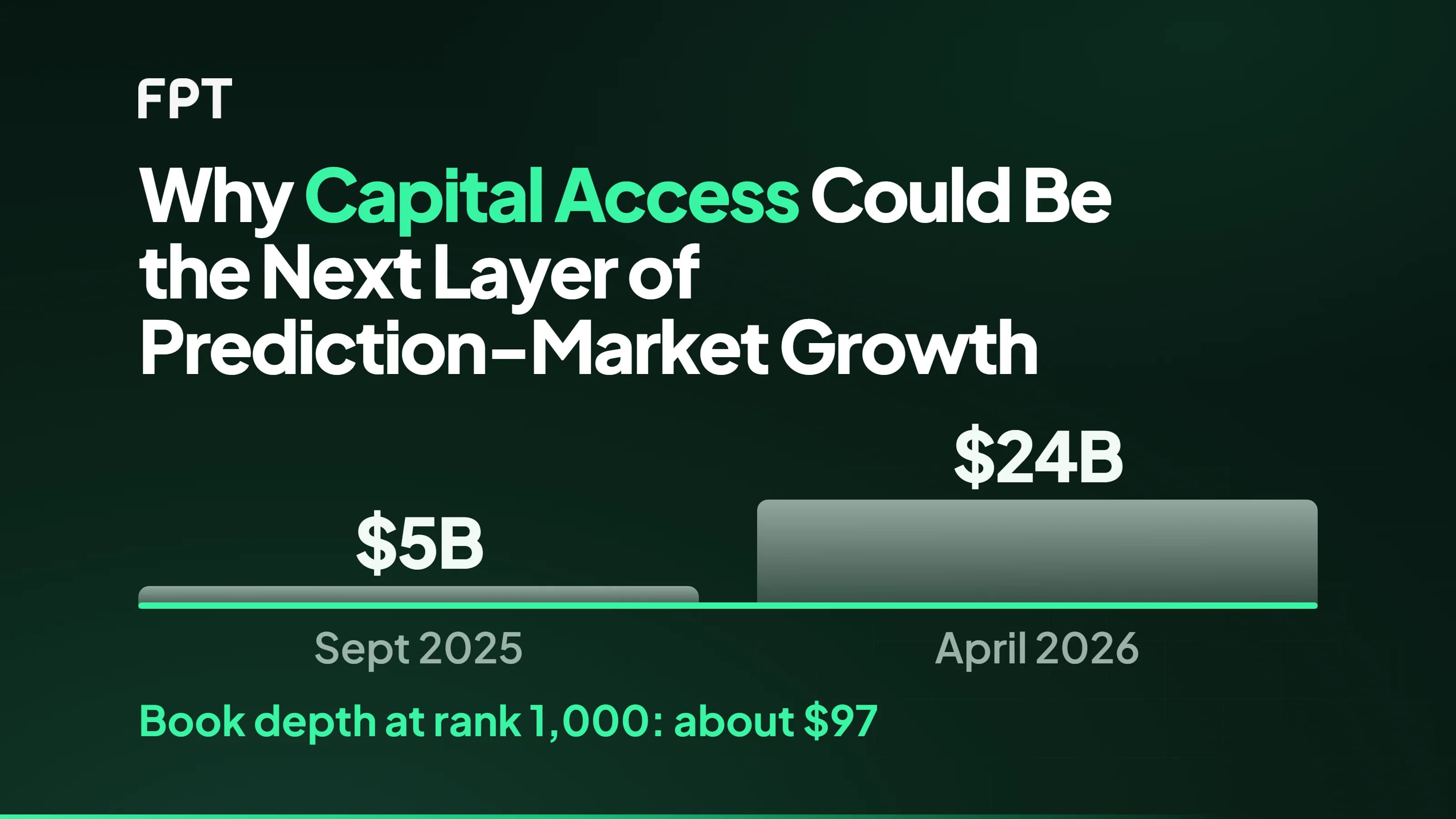
Prediction markets grew roughly fivefold in combined monthly volume between September 2025 and April 2026, to about $24 billion. Depth did not follow. A full census of both venues found 100 markets carrying more than half of the day's trading.
- About $24 billion in combined monthly volume by April 2026, against under $5 billion the previous autumn.
- Sports now drives most of Kalshi's volume. Politics drives almost none of it.
- Most listed markets on both venues traded nothing at all on census day.
- Depth near the price, not headline volume, sets the size a contract can take.
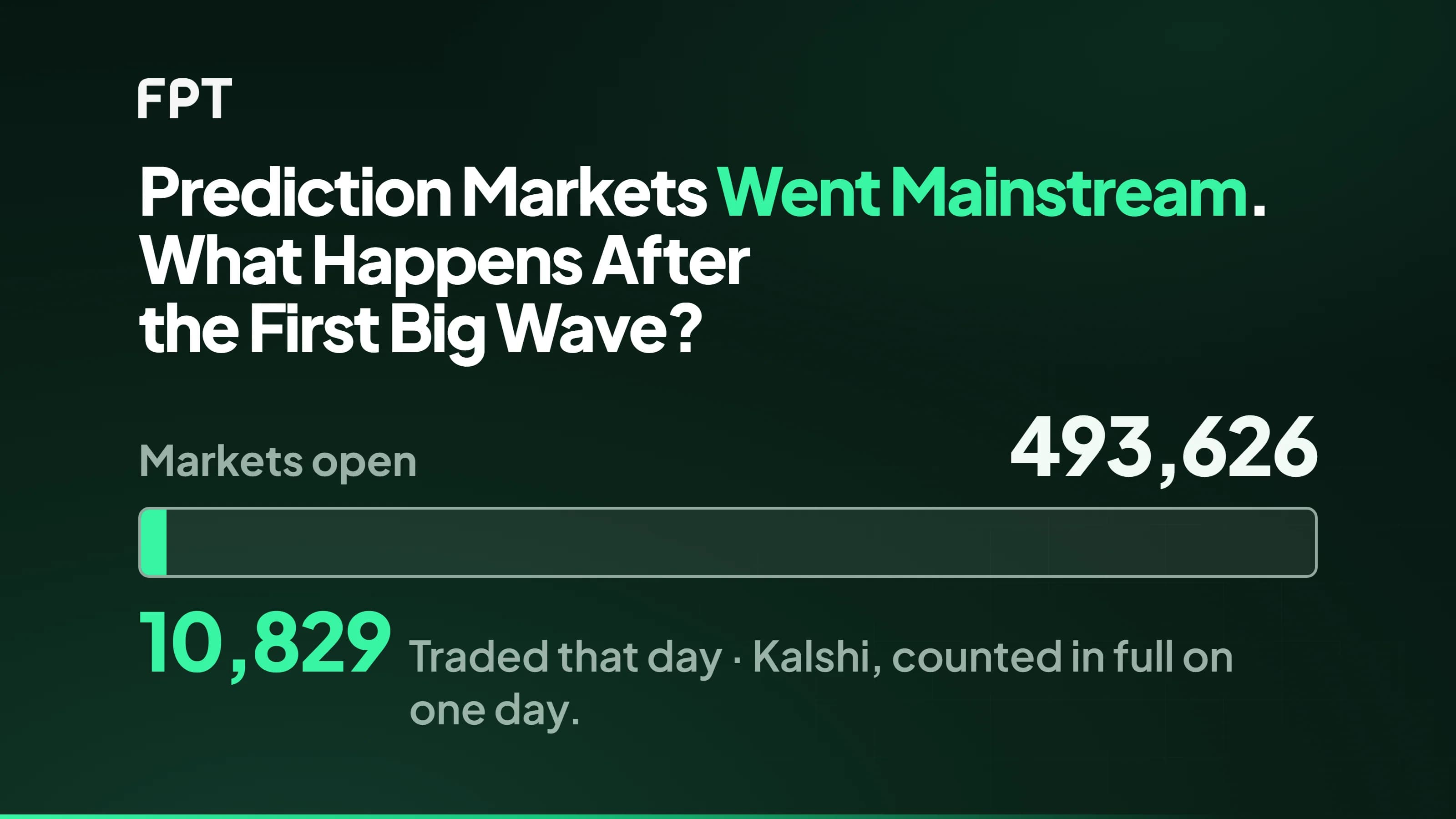
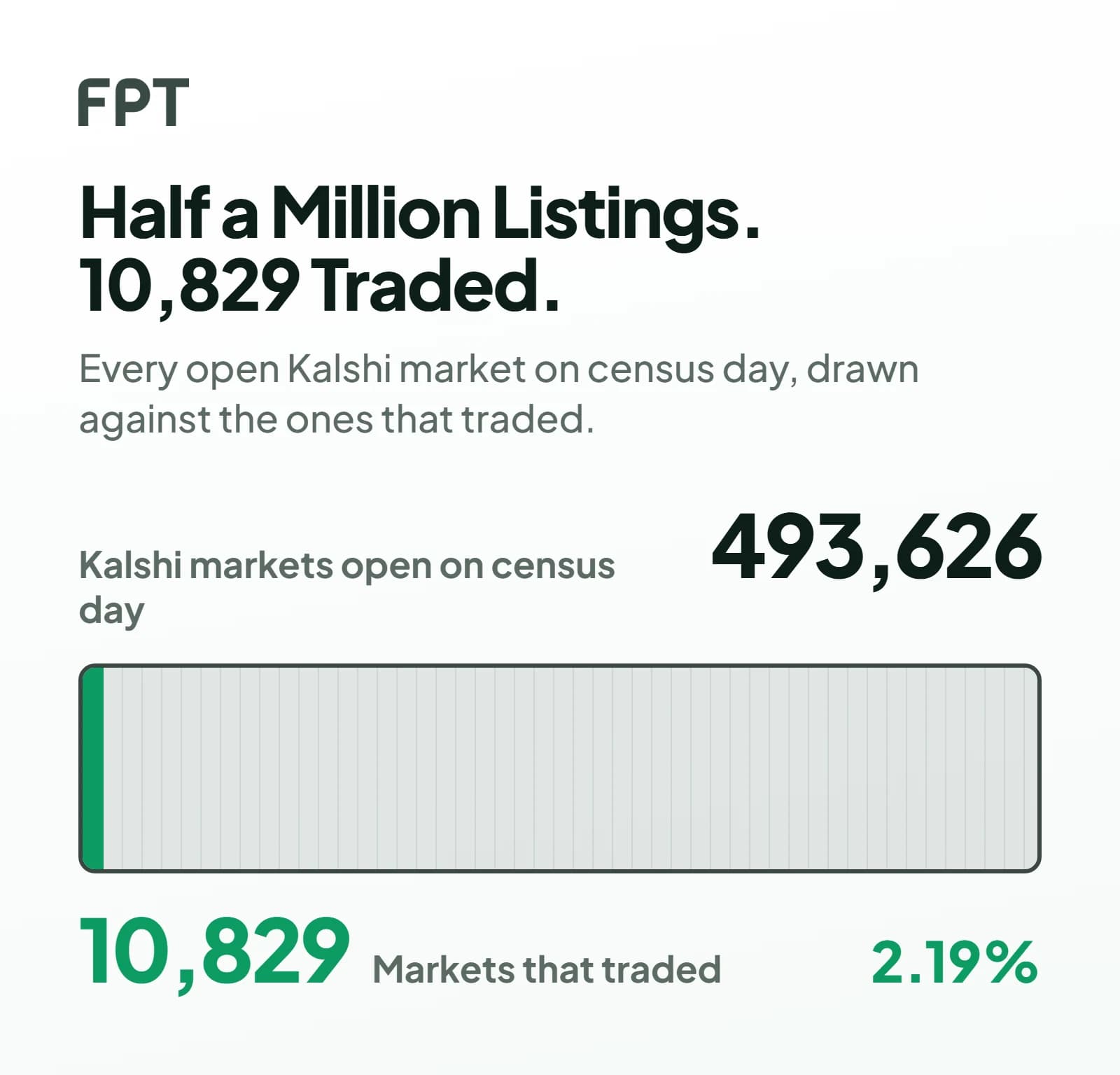
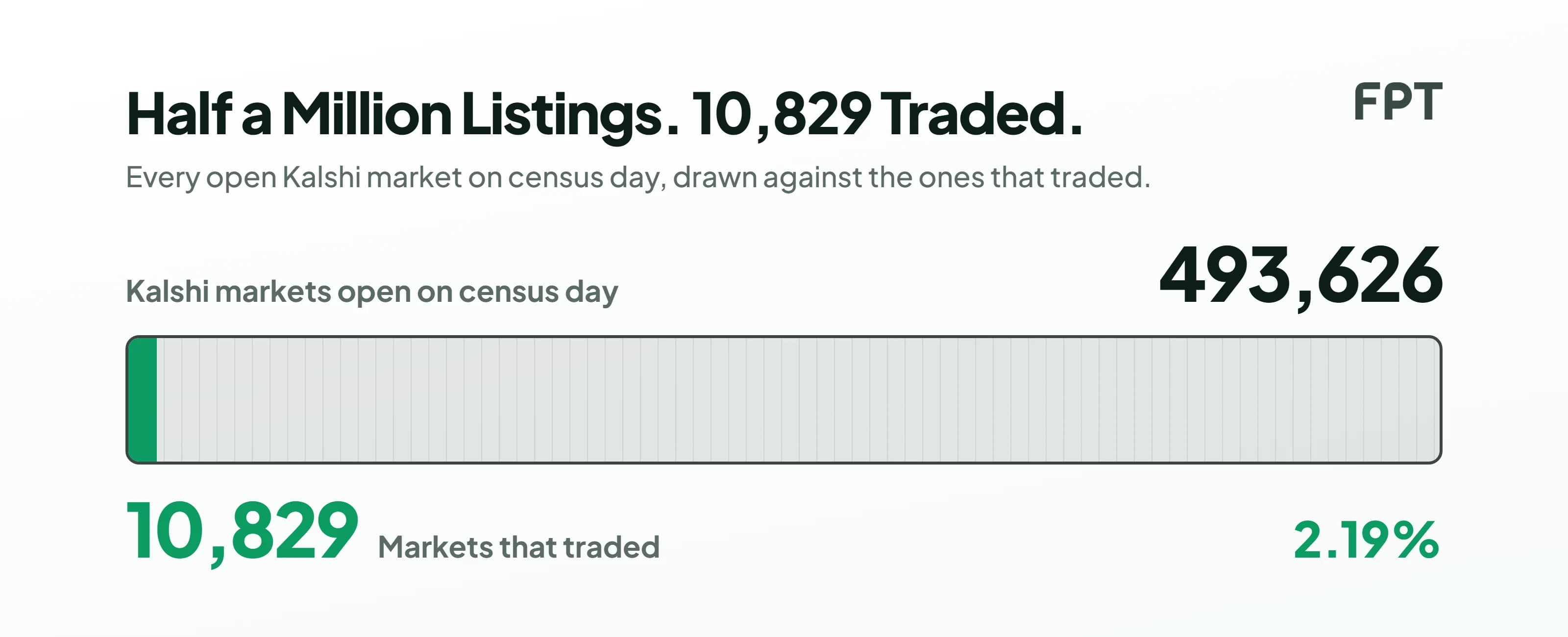
Kalshi lists close to half a million markets. On the day we counted, fewer than eleven thousand of them traded at all.
That is what the growth headline hides. Combined monthly volume across Kalshi and Polymarket reached about $24 billion by April 2026, up from under $5 billion the previous autumn, per Pew Research Center. The category found an audience. It has not found depth.
So we counted it ourselves. We paginated both venues' public APIs to exhaustion and asked one question: where does a single day's trading actually land? The two exchanges share almost no technology. The answer came back nearly identical.
What The Census Changes For You
If you trade these markets, the headline number is not your problem. Your problem is how much size you can get filled without moving the price against yourself.
Funded Prediction Trader (FPT) publishes this blog, and we run a funded-trader program for prediction-market traders. That is who is asking, and it gives us a commercial interest in the answer, so we are showing you the raw count rather than a conclusion.
What Drove The First Wave
Three things landed inside eighteen months, and their order explains everything after them.
How the first wave arrived
- Oct–Nov 2024
The election did the introducing
Political contracts were about 90% of Kalshi's volume and 65% of Polymarket's over those two months.
- 2025
Distribution arrived
Robinhood opened a hub routing to KalshiEX, and a CFTC order let Polymarket onboard brokerages directly.
- By Apr 2026
Sports took over
Sports is now about 80% of Kalshi's volume; politics is down to 4%. Polymarket's mix runs flatter.
Why The Legal Address Matters
US event contracts trade on designated contract markets, under federal oversight. The CFTC's proposed rule describes what that structure does to a price:
The underlying price for an event contract is determined by market participants' continuous buying and selling reaching an equilibrium through a quote-based system.
Footnote 6 contrasts that with a sportsbook, where the operator sets and moves the odds. Nobody quotes you a number here. You are trading against other people, which is why the screen reads differently once you are inside it.
Where A Day's Volume Actually Sits
Two official-looking numbers exist, and they count different things. The CFTC puts registered prediction markets above $25 billion for all of 2025. Pew puts two venues at $24 billion in a single month. Do not add them together.
Markets open or active
- Polymarket
- 80,443
- Kalshi
- 493,626
Share that traded nothing
- Polymarket
- 84%
- Kalshi
- 98%
Markets that traded
- Polymarket
- 12,759
- Kalshi
- 10,829
Top 100 markets' share of the day
- Polymarket
- 56.8%
- Kalshi
- 55.9%
| Measure | Polymarket | Kalshi |
|---|---|---|
| Markets open or active | 80,443 | 493,626 |
| Share that traded nothing | 84% | 98% |
| Markets that traded | 12,759 | 10,829 |
| Top 100 markets' share of the day | 56.8% | 55.9% |
Both venues counted in full on July 26, 2026, a Sunday, which tilts the mix toward sports.
The Same Curve On Two Different Machines
One venue is an on-chain order book. The other is a US futures-style exchange with its own clearing. They agree on almost nothing, yet their concentration curves land on top of each other. The differences deserve a venue-by-venue read, but this shape is the category, not a quirk.
Volume Is Not Depth
Depth is the money sitting in the book right now, near the current price, that you can trade against without moving it.
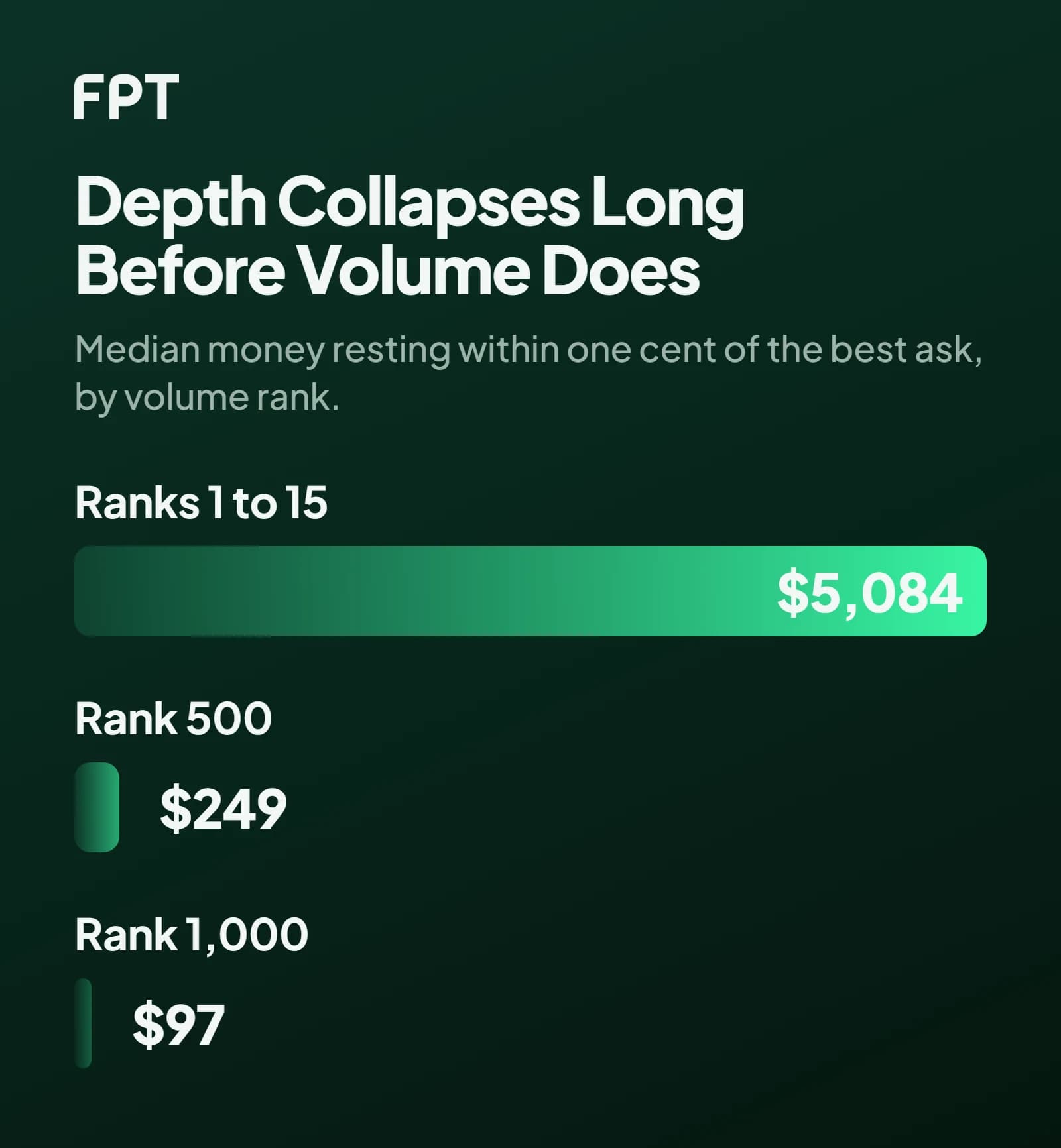
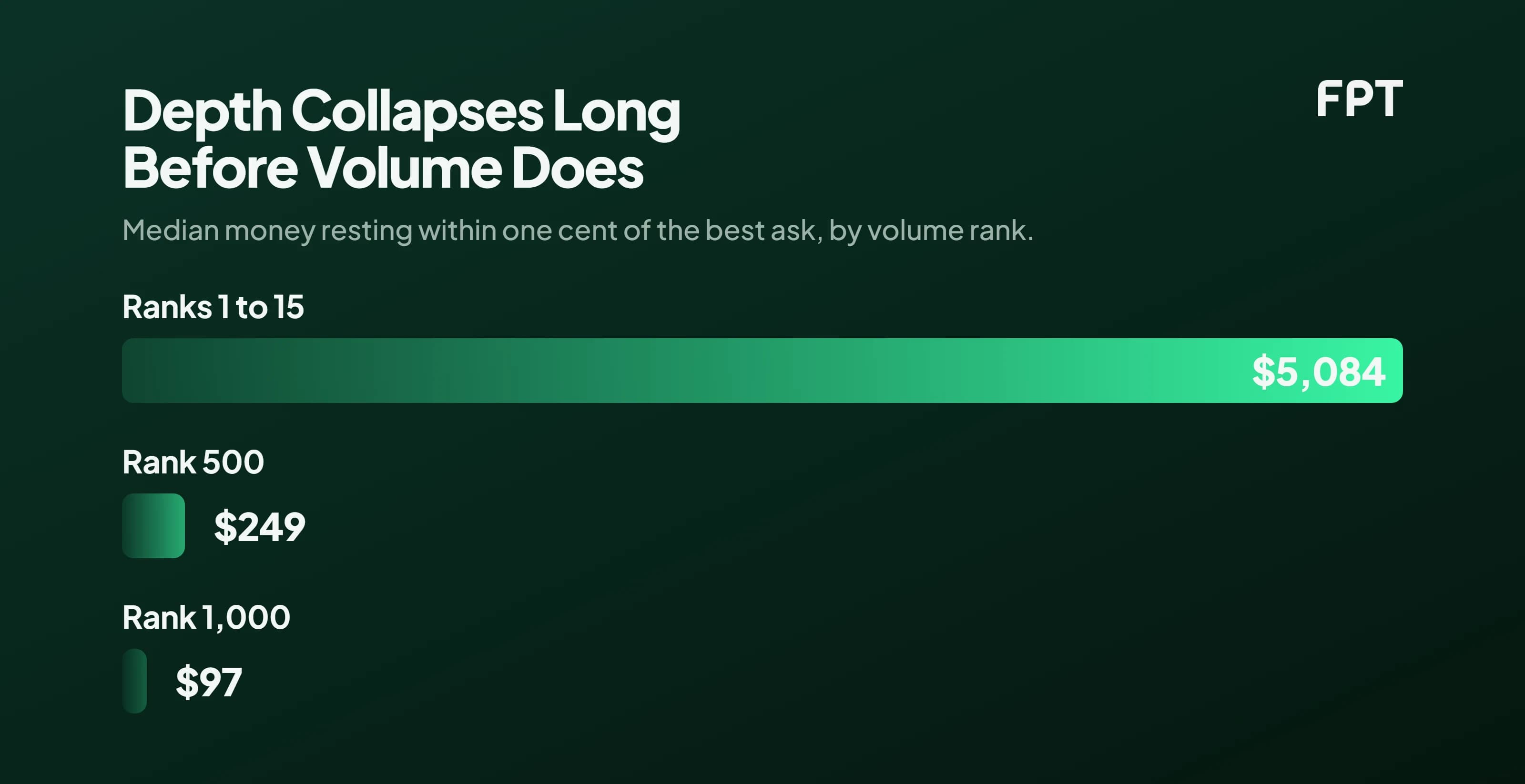
Read that as a ceiling on your own order. Size a position off a monthly headline and you are reasoning about a hundred contracts, not the one you are entering.
Three Things To Check Before You Enter A Market
Listed Is Not Tradeable
Kalshi had 430,884 open multivariate combination markets on census day. Not one of them traded in the twenty-four hours we measured. A listing tells you a market exists. It does not tell you anyone is standing on the other side of it.
How Each Venue Resolves A Market
Both venues take settlement seriously, in opposite directions. Read how a contract resolves before you enter it, not after.
Two ways a market gets settled
Polymarket
UMA Optimistic Oracle
- A proposer posts a bond; anyone can dispute inside two hours.
- A twice-disputed outcome goes to a token vote, landing in four to six days.
Kalshi
Central settlement
- Each contract names its own verification source on its page.
- The markets team reviews a market before its outcome is set.
Both routes leave you the same exposure. You can be right about the world and still lose on the settlement. The paperwork drifts, too: Polymarket's own page calls the proposer bond typically $750, yet none of the busiest markets we sampled carried that value.
Access Is Fragmented By Law, Not Technology
The Third Circuit shielded Kalshi's sports contracts from New Jersey in April 2026, over a dissent. A New York judge denied the same relief three months later. The CFTC has sued four states over jurisdiction, Arizona charged KalshiEX with twenty misdemeanor counts, and France blocked Polymarket's site.
Federal legality on a designated exchange is not in dispute. State gaming law over sports contracts is unresolved, so what you can reach depends on where you are.
Where The Stack Still Has Room
Look at who is posting the prices. TRM Labs read every wallet quoting across Polymarket's largest markets in early 2026, and found almost all of it coming from two groups: mid-frequency traders and full-time market makers.
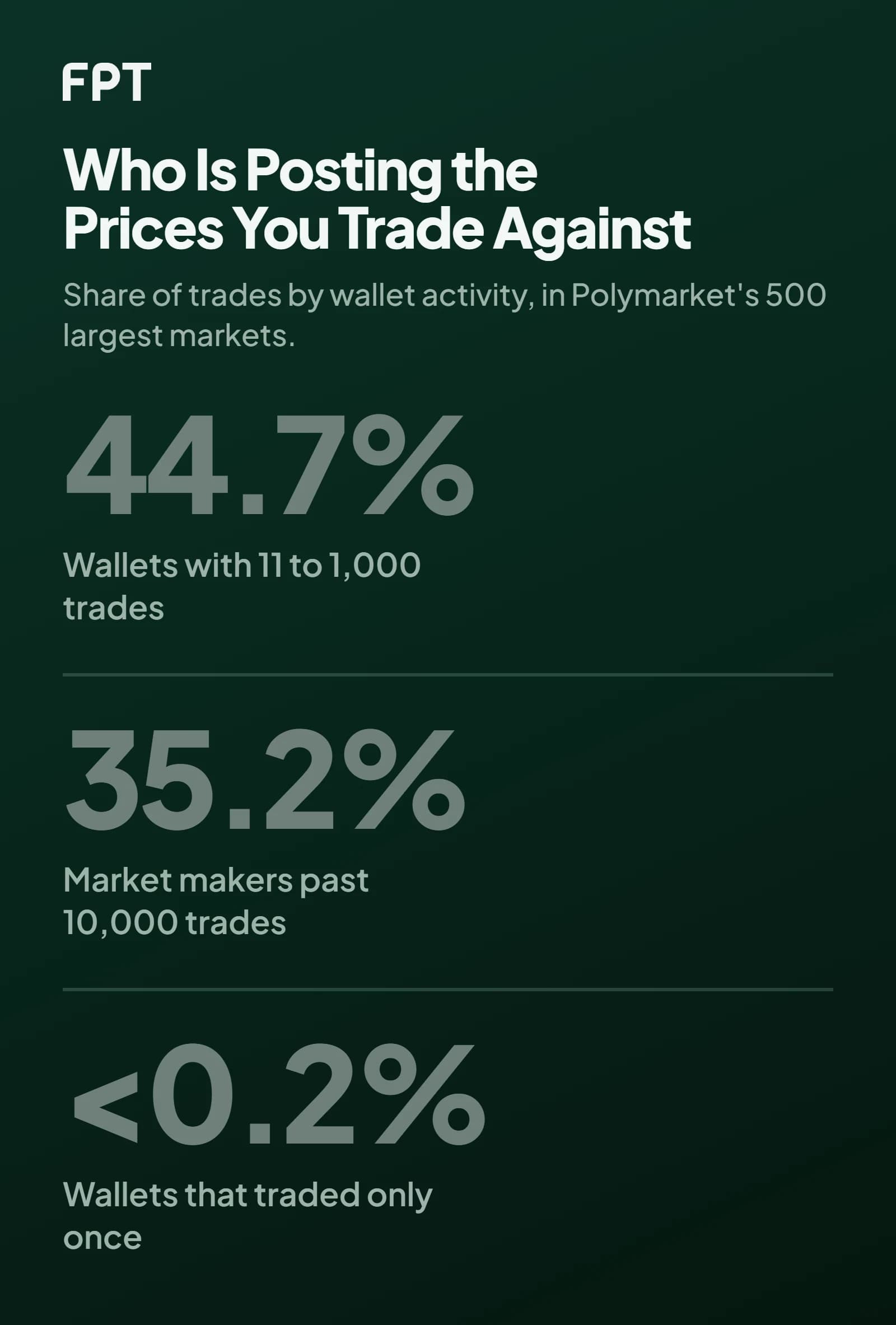
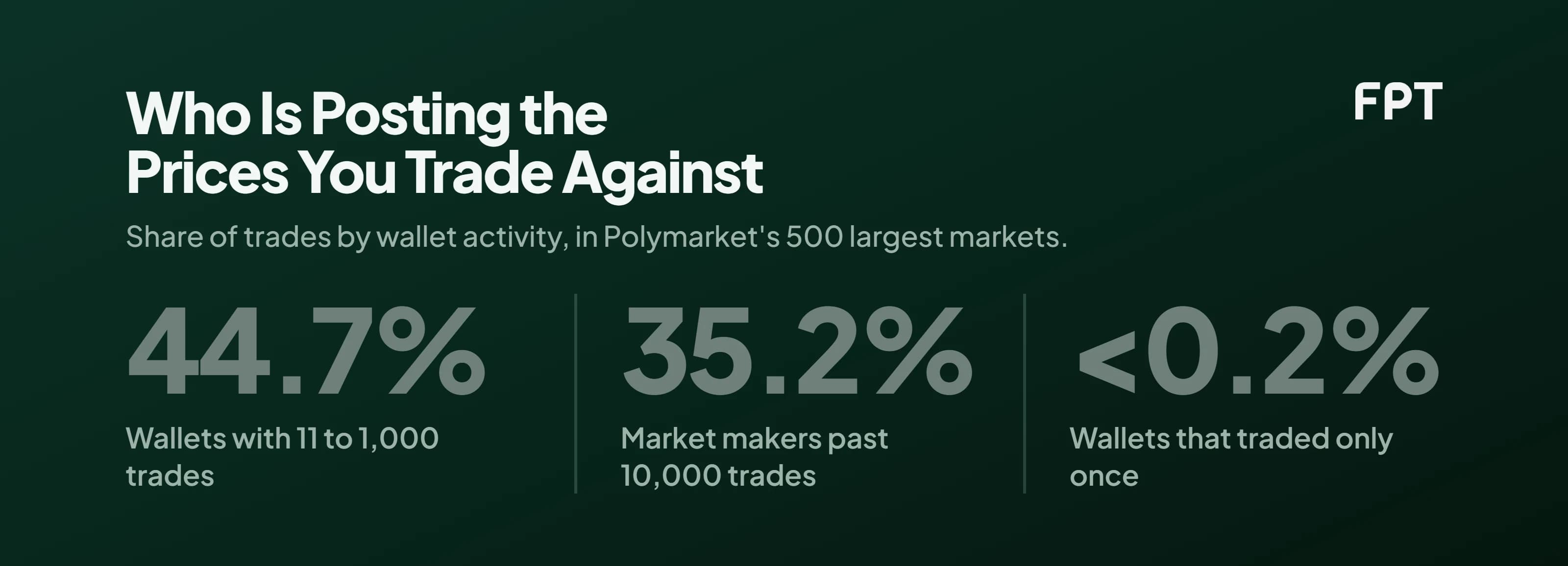
The stack built around that population is nearly complete, with one gap.
The prediction-market stack
- VenueBuilt
- DistributionBuilt
- Market dataPriced
- LiquidityPartial
- Trader capitalEmpty
Four of those layers have a business behind them. Both exchanges sit on the CFTC's register, brokerage hubs route retail orders into them, ICE invested to distribute Polymarket's data, and makers earn a daily rebate, but only where the flow already is. The fifth has almost nothing in it for a directional trader with an edge in a thin contract.
The good opportunities sit in the thin part of the book, which is exactly where your own stack binds hardest. Adding money to a market with $97 near the touch does not make it a $970 market. It makes you the reason the price moved.
How Sizing Works On An FPT Scale Account
So the missing layer cannot be money alone. It needs a size rule tied to the depth of the contract in front of you. On an FPT Scale account, sizing is in dollars and capped twice: total exposure by your max open size, and any one market by a share of its daily volume.
Say you are working through the evaluation on a $50k FPT Scale account and you find a thin contract you like. That $50,000 is the benchmark your profit target, max loss and trailing drawdown are measured against, not money handed to you.
Worked example
Sizing one position on a $50k FPT Scale account
- Account size
- $50,000
- Evaluation max open size
- $2,000
- The market's daily volume
- $10,000
Your ceiling tracks the book, not the account.
Whether that deepens the long tail or just adds flow to the busiest contracts is unresolved, and we have an obvious commercial interest in the answer. The argument and its objections sit in the case for capital access; the mechanics are in what a prop firm for this market is.
What Would Tell You Wave Two Started
A forecast without a date is commentary. Here are five you can answer against the same census on July 26, 2027.
Signals to check, one year on
- Top-100 concentration falls below 45% on either venue, from roughly 56% today.
- The CFTC finalizes its proposed gaming definition.
- Non-sports categories hold above a third of combined volume for a full quarter.
- A venue or a tracker starts publishing order-book depth per market.
- A capital-access program publishes a verified twelve-month payout record. None exists today, ours included.
Both APIs are public and the pagination is documented, so run the count on your own day. If four of five land, wave two has started.
Sources & Method
Category-growth figures come from Pew Research Center's published series and from the CFTC's own proposed rule. The concentration and depth numbers were measured for this article on July 26, 2026 by paginating Polymarket's Gamma API and Kalshi's public trade API to exhaustion and sampling live order books; regulatory and corporate facts are taken from the agencies', courts' and companies' own documents.
- Trading volume on prediction markets has soared in recent months — Pew Research Center, May 27, 2026. Accessed Jul 26, 2026.
- Polymarket Gamma API, /markets/keyset market census endpoint — Polymarket. Accessed Jul 26, 2026.
- Kalshi Trade API, markets endpoint — Kalshi. Accessed Jul 26, 2026.
- Polymarket CLOB API, order book endpoint — Polymarket. Accessed Jul 26, 2026.
- Prediction Markets; Public Interest Determinations (proposed rule, RIN 3038-AF65) — Commodity Futures Trading Commission, Jun 12, 2026. Accessed Jul 26, 2026.
- KalshiEX, LLC v. Flaherty, No. 25-1922 (opinion of the court) — United States Court of Appeals for the Third Circuit, Apr 6, 2026. Accessed Jul 26, 2026.
- CFTC Sues Trio of States to Reaffirm its Exclusive Jurisdiction Over Prediction Markets — Commodity Futures Trading Commission, Apr 2, 2026. Accessed Jul 26, 2026.
- CFTC Sues New York Over Prediction Markets Amid Ongoing Efforts to Preserve Jurisdiction — Commodity Futures Trading Commission, Apr 24, 2026. Accessed Jul 26, 2026.
- Arizona Files First Criminal Charges Against a Prediction Market — Morgan Lewis, Mar 25, 2026. Accessed Jul 26, 2026.
- Polymarket statement on ANJ ruling — PR Newswire, Jul 22, 2026. Accessed Jul 26, 2026.
- Robinhood Launches Prediction Markets Hub — Robinhood, Mar 17, 2025. Accessed Jul 26, 2026.
- Polymarket Receives CFTC Approval of Amended Order of Designation Enabling Intermediated US Market Access — PR Newswire, Nov 25, 2025. Accessed Jul 26, 2026.
- Prediction Markets — Webull. Accessed Jul 26, 2026.
- ICE Announces Strategic Investment in Polymarket — Intercontinental Exchange, Oct 7, 2025. Accessed Jul 26, 2026.
- Polymarket Exchange Upgrade: April 28, 2026 — Polymarket, Apr 28, 2026. Accessed Jul 26, 2026.
- Resolution — Polymarket. Accessed Jul 26, 2026.
- Maker Rebates Program — Polymarket. Accessed Jul 26, 2026.
- How Prediction Markets Scaled to USD 21B in Monthly Volume in 2026 — TRM Labs, Mar 27, 2026. Accessed Jul 26, 2026.
- Fee Schedule for July 2026 (7.7.26 Update) — Kalshi, Jul 7, 2026. Accessed Jul 26, 2026.
- Kalshi Launches First-Ever Perpetual Futures in America — Kalshi, May 29, 2026. Accessed Jul 26, 2026.
- Trading Organizations, Industry Filings — Commodity Futures Trading Commission. Accessed Jul 26, 2026.
- Market Rules — Kalshi. Accessed Jul 26, 2026.
- Kalshi appeals after federal judge sides with New York gambling regulators — Gothamist, Jul 8, 2026. Accessed Jul 26, 2026.
Common Questions
How big are prediction markets in 2026?
Pew Research Center, analyzing data from The Block, put combined monthly trading volume on Kalshi and Polymarket at about $24 billion in April 2026, up from less than $5 billion in September 2025. The CFTC separately stated that volume across CFTC-registered prediction markets exceeded $25 billion across all of 2025. The two figures measure different universes and should not be added together.
Why is prediction-market liquidity so concentrated?
Listing a contract is nearly free; attracting two-sided flow to it is not. On a complete census of both venues taken on July 26, 2026, the top 100 markets carried 56.80% of Polymarket's 24-hour volume and 55.88% of Kalshi's, while 84% of Polymarket's active markets and 98% of Kalshi's open markets traded nothing at all.
Are event contracts legal in the United States?
Event contracts trade on designated contract markets under CFTC oversight, and that federal framework is not in dispute. Whether individual states may apply gaming law to sports event contracts is unresolved as of July 26, 2026: the Third Circuit sided with Kalshi at the preliminary-injunction stage in April 2026 over a dissent, a federal judge in New York denied Kalshi the same relief in July 2026 and Kalshi appealed, the CFTC has sued four states to assert exclusive jurisdiction, and a CFTC rulemaking on the question is open. Availability depends on your location and venue access.
What is the difference between prediction-market volume and depth?
Volume counts what already traded over a period. Depth is the money resting in the order book right now, close to the current price, that you could trade against without moving it. In sampling Polymarket's live books on July 26, 2026, markets ranked around 1,000 by volume showed a median of roughly $97 within a cent of the best ask, so a headline monthly volume figure says almost nothing about the contract you are about to enter.
Referenced on this site