TL;DR
Funded Prediction Trader runs a futures-style evaluation on prediction-market event contracts, on an FPT Scale account: one phase, one profit target, a 90% split. Two mechanics break from the futures norm. Exposure is capped in dollars account-wide, each market at a share of its daily volume, and consistency is enforced twice at 40%.
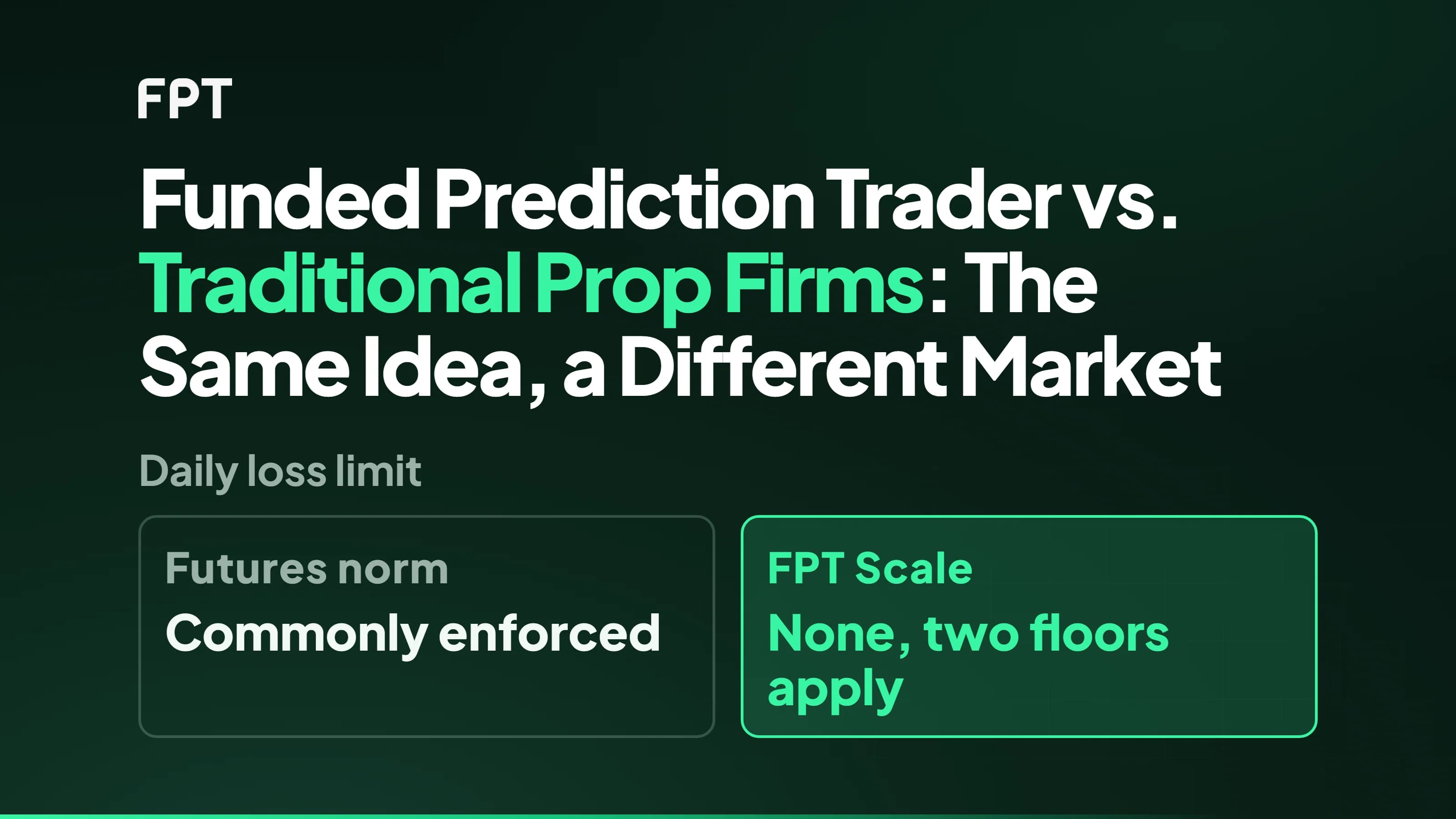
- No separate daily loss limit, the rule futures evaluations commonly enforce. A max loss and an end-of-day trailing floor still apply.
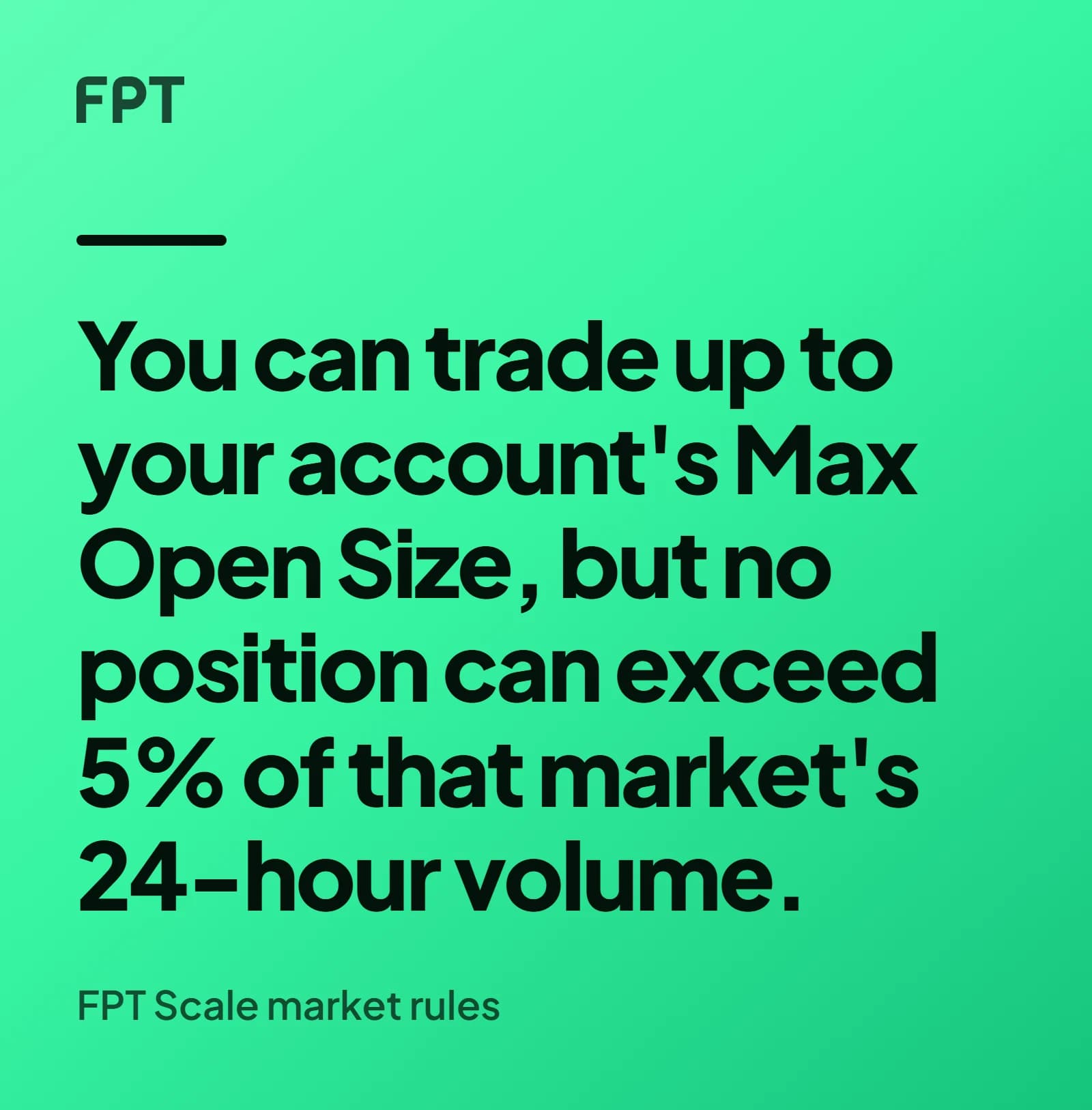
- Available size is the lower of what your max open size has left and 5% of a market's volume.
- Consistency is 40%, checked in the evaluation and again in each payout cycle.
- 90% to you from the first payout, sent within 48 hours of approval.
Most of this will feel like a Tuesday. One phase, a profit target, a trailing floor, five qualifying days, ninety percent of the profit to you. The skeleton of a futures evaluation, lifted whole and set down on event contracts.
Two mechanics are genuinely new, and both work differently from the futures norm. One decides how big a position you are allowed to hold. The other decides how evenly your profit has to arrive. Everything else you already know how to do.
One Familiar Rule Sheet, One New Line
Funded Prediction Trader applies the prop-firm model to prediction markets, on event contracts rather than futures, and its FPT Scale account is where that happens: pass an evaluation, trade a funded account, get paid, unlock more size. Read its rule sheet against the futures and forex norm — first-party evaluation and payout pages, July 2026, no one named firm — and almost every line has a counterpart you have already traded under. One line does not.
That is the volume cap, and the section below works it through. Everything around it is the evaluation model you already know. Position size and consistency are the two rules that genuinely differ, and the sections below work through both.
What You Are Actually Trading
A futures contract carries a tick value and a delivery month. An event contract carries neither. It settles at $1 if a stated outcome happens, and at $0 if it does not. Polymarket and Kalshi both come with every account, and both sit on the CFTC's designated-contract-market register, Polymarket through its US entity. Venue availability may depend on your location, exchange access, market availability and applicable restrictions.
Why the Price Is the Probability
The price is the forecast. A contract trading at sixty-three cents is the book saying the outcome looks roughly sixty-three percent likely. You are not picking a winner. You are buying a probability at a price, and deciding whether that price is wrong.
Two prices, two probabilities
Position Size Is Set by the Book
A futures program caps you in contracts, and that cap binds long before a liquid order book does. FPT caps you in dollars instead: max open size runs from $1,000 to $3,000 in the evaluation, depending on account size. That figure is the total you can have open at once, across every position together. Then the second cap lands, the one quoted at the top of this piece: any one market is capped at 5% of its 24-hour volume, and an order over either limit is blocked before it goes through rather than counted as a breach. What a market will let you open is whichever is smaller — what your account has left, or that market's 5%.
The Volume Cap, Worked Through
Suppose you want the same position twice in one afternoon, once in a busy market and once in a quiet one. The account limit is identical both times. What you are allowed to hold is not, because the second cap is set by the market rather than by your account.
Worked example
One limit, two very different markets
- Account
- $50k FPT Scale evaluation
- Max open size
- $2,000
- Quiet market, volume that day
- $10,000
- Busy market, volume that day
- $100,000
Same account, same afternoon, four times the size.
Why Depth Is the Real Constraint
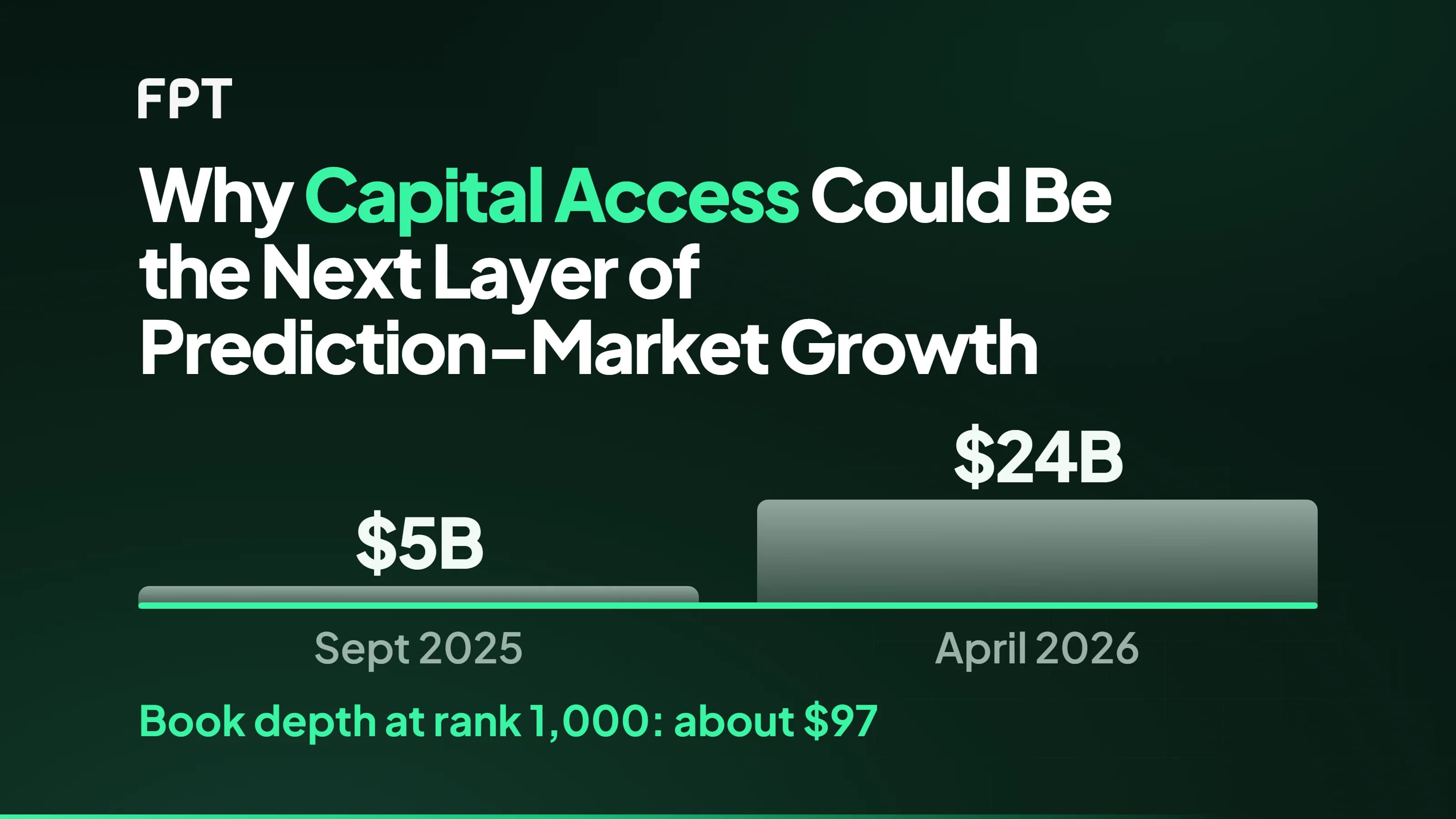
That cap only hurts where volume is thin, and volume is thin almost everywhere. Sampled in July 2026, the median market inside Polymarket's fifteen busiest held about $5,000 of asks within a cent of the touch. A few hundred ranks down, that number collapses to the low hundreds.
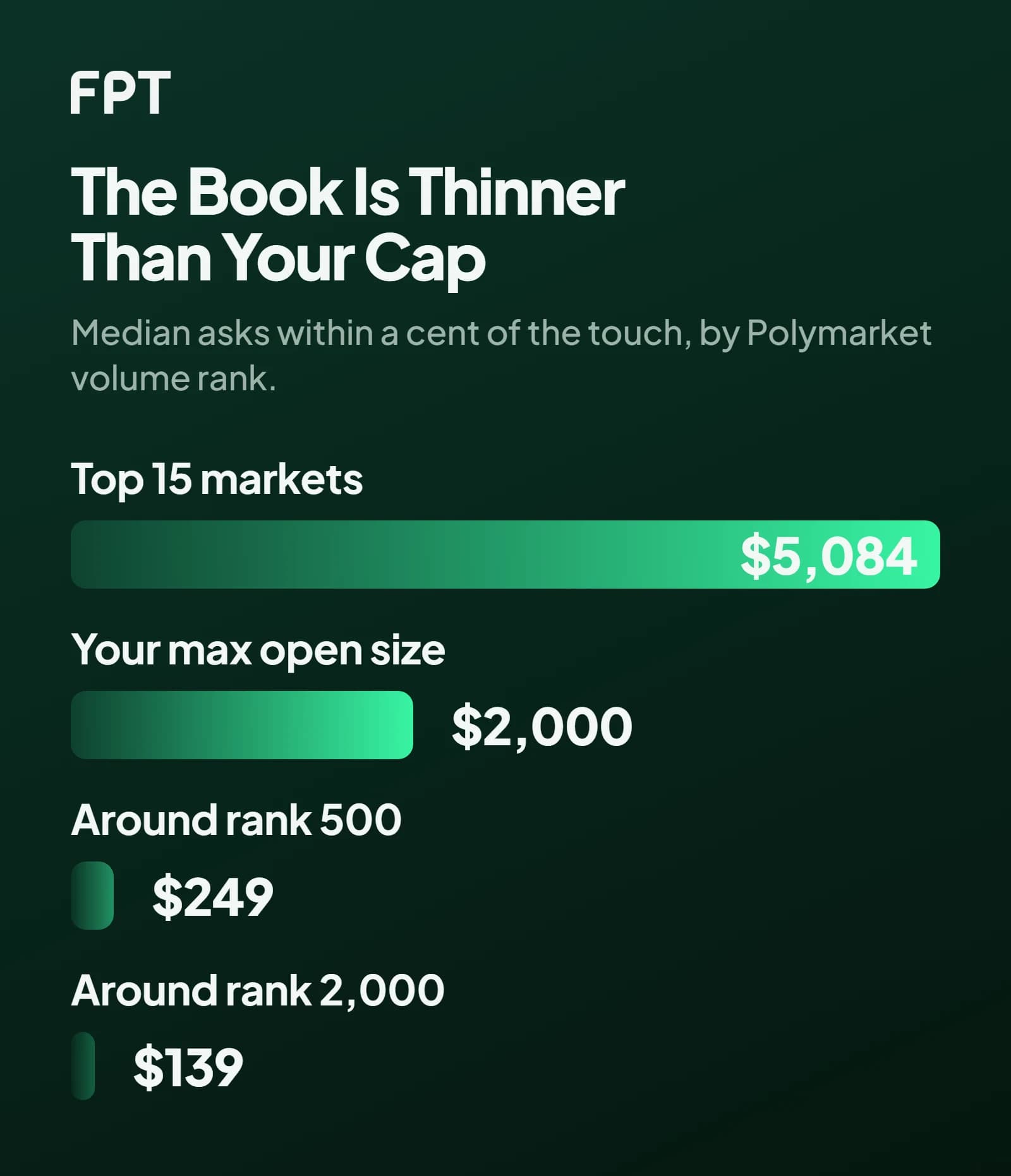
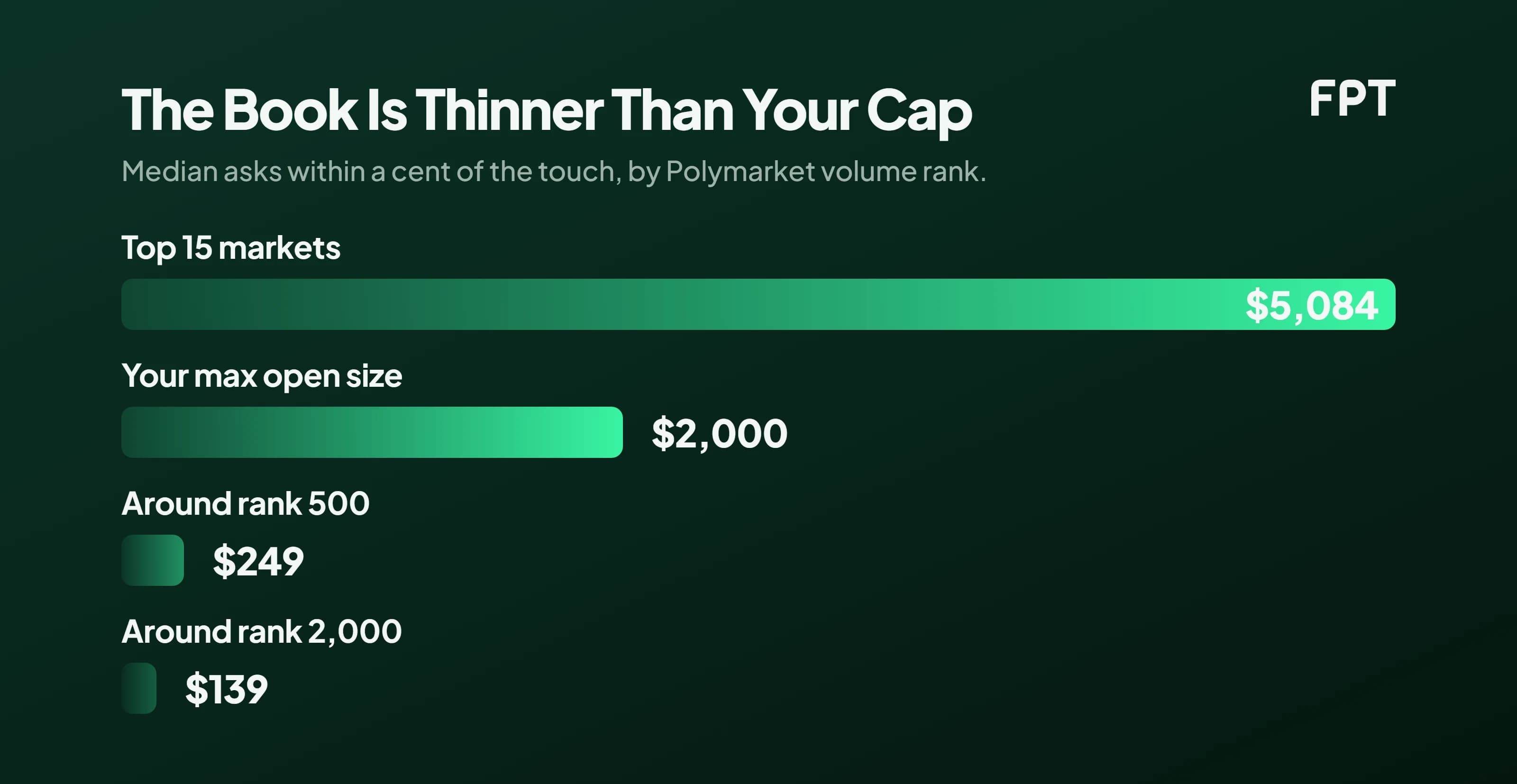
A contract cap assumes depth. A dollar cap plus a volume cap assumes nothing. Your risk discipline carries over almost untouched; your sizing instinct does not, and the rest of that transfer list is worth an hour before you buy anything.
Drawdown: No Daily Limit, Two Hard Floors
This one goes FPT's way. No account size carries a separate daily loss limit, while futures programs commonly enforce one. What stays is a max loss, $2,000 on the $50k, and an end-of-day trailing floor that locks near your starting balance, roughly $100 above it.
Why End-of-Day Beats Intraday
Drawdown type matters more than most marketing admits. A floor that chases your intraday equity peak counts unrealised profit, so a trade that runs deep into the green and gives it all back has already spent that budget for good. An end-of-day floor forgives the round trip, in the sense that an intraday high never raises it — though the floor itself is live at every moment, and touching it mid-day ends the account.
The 40% Consistency Rule, Applied Twice
Here is the rule futures traders miss most often. No single day may account for more than 40% of your total profit. On the $50k evaluation that caps any one day at $1,200 of the $3,000 target. Clear the whole target in one session and it will not satisfy the rule, and the same test runs again in every funded payout cycle.
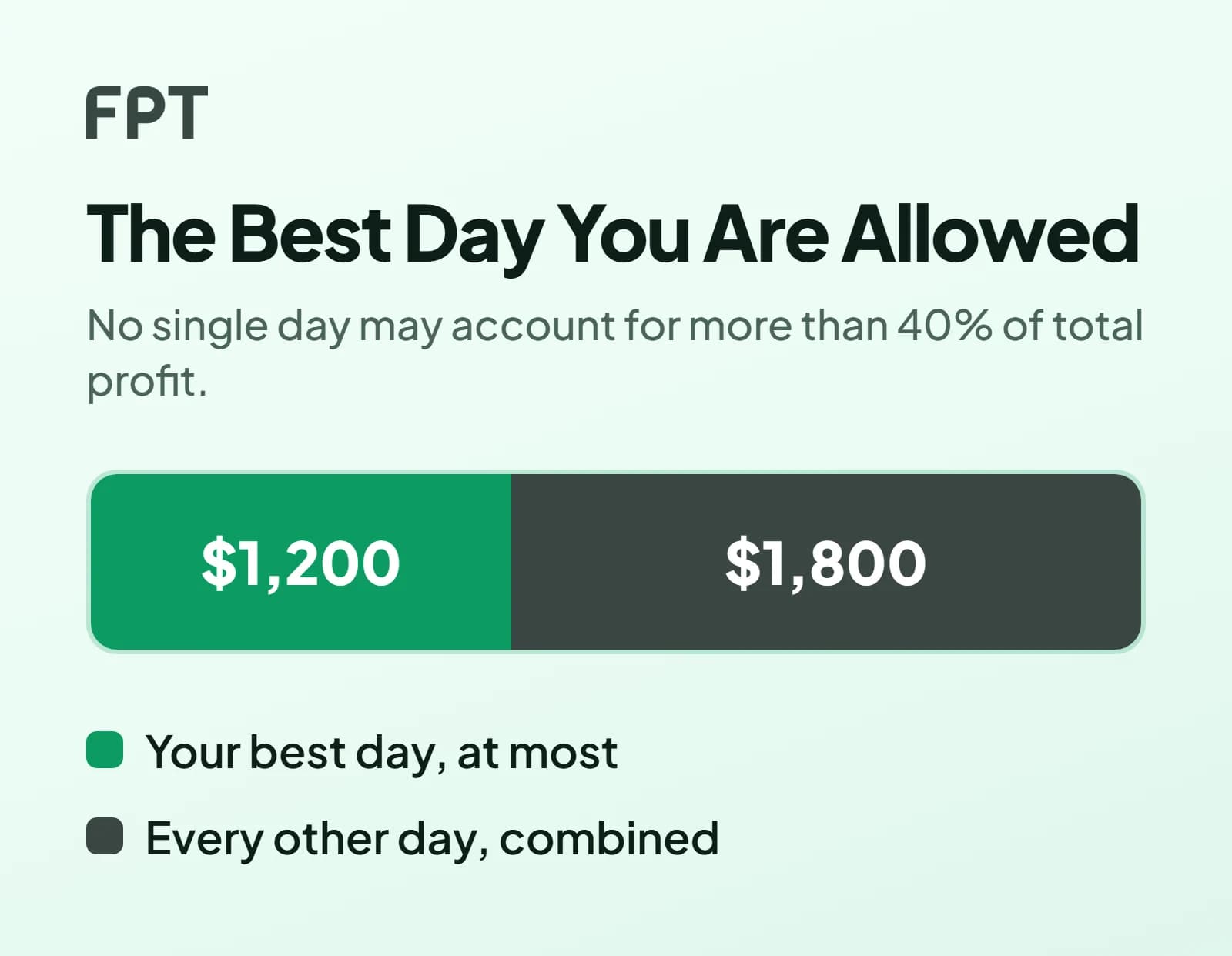
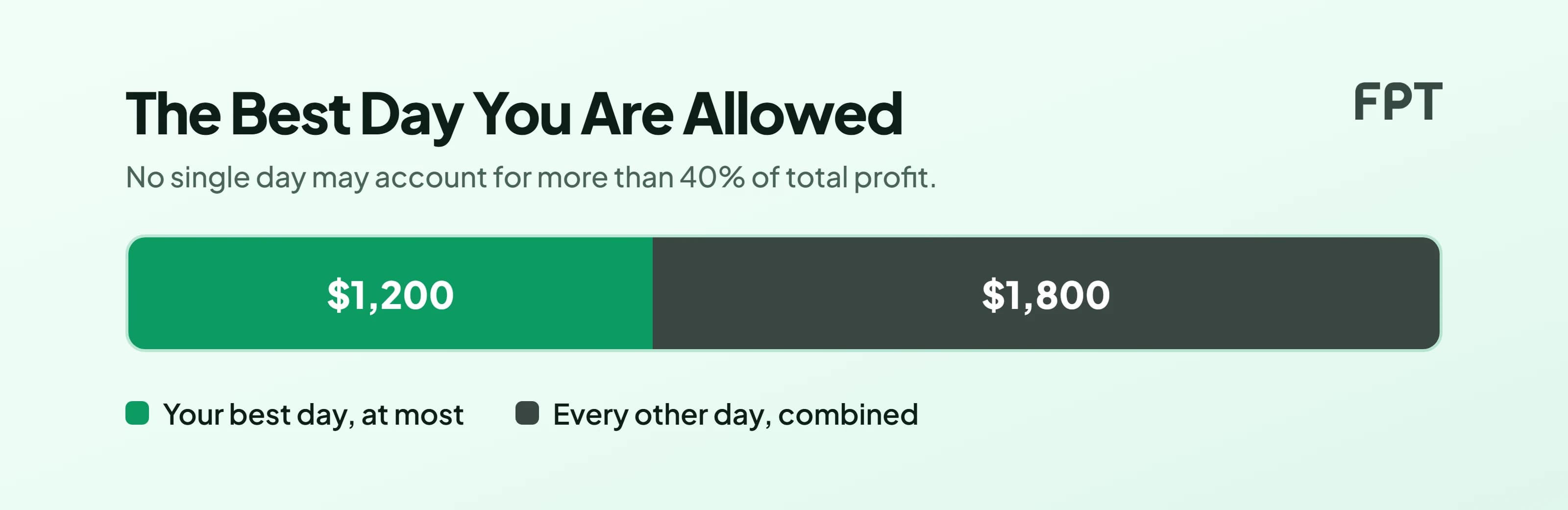
The category norm is looser on both counts. Futures programs commonly set the ratio at 50%, and commonly publish it as an evaluation objective rather than a funded one. They also treat going over it as a deferral rather than a failure: on one, exceeding the ratio raises the profit target instead of failing the account; on another, you trade extra days until the average settles. FPT works the same way. Going over 40% is not a breach and does not fail the account — it means you cannot pass, or request a payout, until further profitable days bring the ratio down, and there is no deadline on doing that.
Payouts and the Ladder
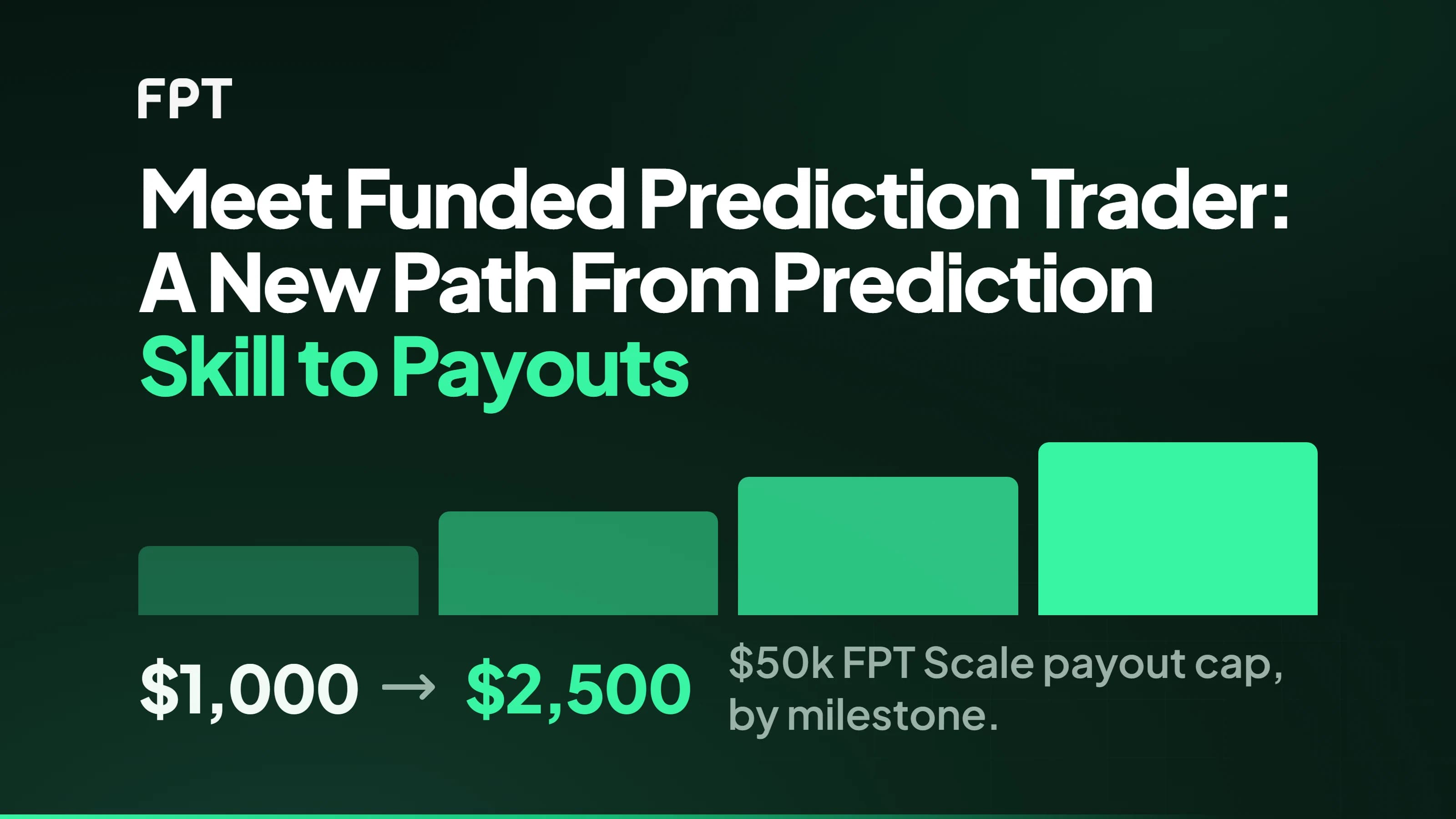
Ninety percent to you, ten to the firm, from the first payout. Published caps are what you can actually receive after the split, so a $1,000 cap means up to $1,000 in hand. A payout cycle is five qualifying days, each clearing a profit minimum set by account size.
Approved payouts are sent within 48 hours of approval — the clock runs from approval rather than from the request.
The $50k payout cap, rung by rung
- First approved payout$1,000
- Second approved payout$1,500
- Third approved payout$2,000
- Fourth payout and beyond$2,500
How Far the Ladder Goes
Read the top rung twice. Approved payouts past the fourth tier move neither the cap nor the size. Funded max open size also opens at $1,000, half of what the same account allowed during its evaluation, and the second approved payout puts it back to $2,000 on the way to $2,500.
Five Accounts, and What the Combined Number Means
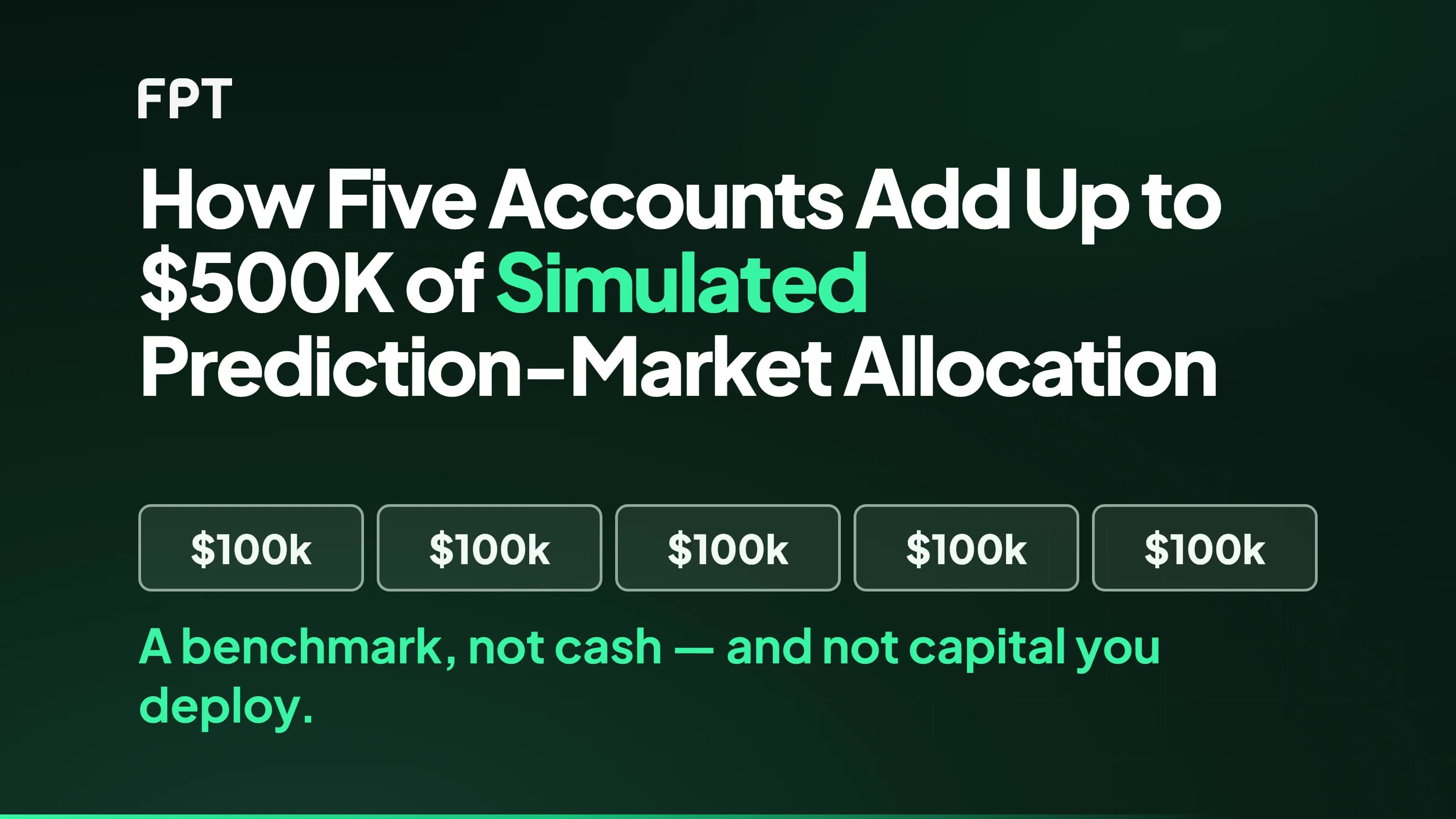
Five accounts is the ceiling per user, evaluation and funded combined, so $500,000 of combined account size at the largest. That figure is a benchmark your profit target, max loss and drawdown are measured against, not money handed to you. Across five fully scaled $100k accounts you could hold $17,500 open at once, and that gap is the most misread thing in the category.
Where FPT Is Simpler
Three places FPT is simpler than the futures norm
- One phase. Many futures evaluations run two stages. FPT Scale has one: one profit target, five qualifying profitable days.
- No separate daily loss limit. The rule a futures evaluation commonly enforces at 3–5% of the account does not exist here.
- 90% from payout one. Category splits commonly start at 80%, or gate 90% behind tenure or a scaling plan. This one does not change.
Where FPT Uses Tighter Controls
Five places FPT sets a tighter control
- Consistency is 40% against a category norm of 50%, and it is checked twice.
- A volume-share cap on every market has no futures equivalent.
- Funded max open size opens below what the same account allowed in evaluation.
- The ladder stops at the fourth approved payout. Cap and size stop moving.
- Funded accounts progress through approved payouts; a funded reset is not sold at launch.
Two of those are structural rather than annoyances. If one conviction a quarter carries your year, the consistency rule is the one to check first: it asks for profit spread across days rather than concentrated in a single resolution.
Where Futures Trading Has Different Advantages
- Tooling. A futures desk has decades of charting and risk software behind it. Prediction-market tooling is younger, and more of the analysis is still yours to build.
- Depth. A liquid futures contract absorbs size around the clock. In a July 2026 census, about a hundred markets carried more than half the day's volume on each venue.
- A public operating history. Established futures firms can point at years of processed withdrawals. FPT is pre-launch, and will publish verified payout and performance data as that history accumulates. What is already published is the part you are buying: the full rule set, the pricing and the payout ladder.
Which Model Fits Your Trading Style
The decision is shorter than it looks. You already know how to trade inside a published rule set, and this is largely the rule set you know: one phase, one profit target, a trailing floor, and 90% of the profit from your first approved payout.
What is genuinely open is whether event contracts suit how you form a view, and whether you are happy working inside a position limit set partly by the market you are trading. If the model is still fuzzy, start with the plain-English version. If it is not, run the full rules against your last hundred trades, then pick a size in the account builder.
Sources & Method
Every FPT figure is quoted from the published FPT Scale offer configuration and checked against the approved offer spec. Every characterization of the futures prop-firm category was read on a first-party evaluation or payout page on July 26, 2026 and is stated as a category norm, never attributed to a named firm in the comparison. Prediction-market depth and concentration figures were sampled directly from Polymarket's and Kalshi's public census and order-book APIs on the same date.
- Trading Objectives — FTMO. Accessed Jul 26, 2026.
- How It Works — FTMO. Accessed Jul 26, 2026.
- Intraday Drawdown Explained — My Funded Futures, Jan 8, 2026. Accessed Jul 26, 2026.
- MAX EOD Trailing — My Funded Futures, Mar 2, 2026. Accessed Jul 26, 2026.
- Payout Policy Overview — My Funded Futures, Feb 22, 2026. Accessed Jul 26, 2026.
- Designated Contract Markets (DCM) — Commodity Futures Trading Commission. Accessed Jul 26, 2026.
- Trading volume on prediction markets has soared in recent months — Pew Research Center, May 27, 2026. Accessed Jul 26, 2026.
- Polymarket Gamma API, active market census endpoint — Polymarket. Accessed Jul 26, 2026.
- Polymarket CLOB API, order-book endpoint — Polymarket. Accessed Jul 26, 2026.
- Kalshi trade API, open-market census endpoint — Kalshi. Accessed Jul 26, 2026.
- Consistency Rule at My Funded Futures — My Funded Futures, Feb 27, 2026. Accessed Jul 26, 2026.
- Consistency at Topstep — Topstep, May 28, 2026. Accessed Jul 26, 2026.
- Scaling and Reward Growth Plan — FTMO. Accessed Jul 26, 2026.
Common Questions
Does an FPT Scale account have a daily loss limit?
No separate daily loss limit applies on any FPT Scale account size. The max loss rule and the end-of-day trailing drawdown still apply and either one can end an account: max loss is $1,000 on the $25k, $2,000 on the $50k and $3,000 on the $100k.
How does FPT's consistency rule compare with the futures norm?
FPT applies a 40% consistency rule, meaning no single day may account for more than 40% of total profit, and it applies in the evaluation and again in every funded payout cycle. Futures programs commonly set 50%, and commonly publish it as an evaluation objective rather than a funded one.
What is the largest position an FPT Scale account can hold?
The lower of what your account has left of its max open size and 5% of that market's 24-hour volume. Max open size caps total open exposure and runs from $500 to $3,500 depending on account size and payout tier, so a thin market can cut an allowed position well below the account limit.
How quickly are FPT payouts paid?
Approved payouts are sent within 48 hours of approval, after a payout cycle of five qualifying days, and 90% of the profit is yours.
Does scaling on an FPT Scale account ever stop?
Yes. Approved payouts raise the payout cap and max open size through four tiers, and the fourth tier is terminal. On the $50k account it stops at a $2,500 cap and a $2,500 max open size; on the $100k account it stops at $3,500 for both.
Referenced on this site